





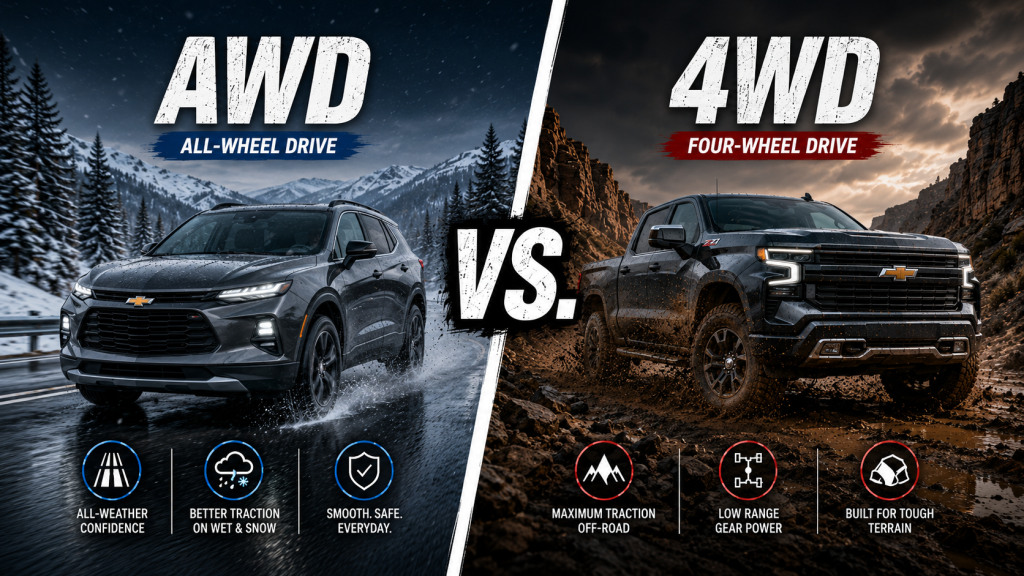
AWD vs. 4WD: What’s Better for Michigan Driving?
If you drive in Michigan, chances are you have thought about whether your next vehicle should have all-wheel drive or four-wheel drive. Between snow-covered roads, icy mornings, gravel roads, muddy driveways, camping trips, and changing weather, having power available at all four wheels can be a major advantage.
But AWD and 4WD are not exactly the same. Each system is designed with different types of driving in mind, and choosing the right one depends on where you drive, how you use your vehicle, and how much capability you actually need.
Here is a simple breakdown of AWD vs. 4WD and what Michigan drivers should consider when shopping for their next car, truck, or SUV.
What Is All-Wheel Drive?
All-wheel drive, commonly called AWD, is designed to help provide additional traction during normal everyday driving. Depending on the vehicle and system, power can be distributed between the front and rear wheels as driving conditions change.
Many modern AWD systems operate automatically. The driver typically does not need to engage the system when the road becomes slippery. Instead, the vehicle can respond to changing traction conditions and direct power where it is needed.
This makes AWD particularly convenient for drivers who regularly encounter snow, rain, wet pavement, loose gravel, or changing road conditions.
What Is Four-Wheel Drive?
Four-wheel drive, commonly called 4WD or 4×4, is generally designed for situations where additional traction and capability are needed.
Four-wheel-drive systems are commonly found in pickup trucks and larger SUVs. Depending on the vehicle, drivers may be able to select different drive modes such as two-wheel drive, automatic four-wheel drive, four-wheel-drive high, or four-wheel-drive low.
A 4WD system can be especially useful when driving through deeper snow, mud, loose surfaces, rough roads, job sites, trails, or other situations where maximum low-speed traction may be important.
AWD vs. 4WD: What’s the Main Difference?
The simplest way to think about the difference is that AWD is generally designed for everyday traction and convenience, while 4WD is generally designed for additional capability in more demanding conditions.
AWD systems are often automatic and require little input from the driver. Four-wheel-drive systems may give the driver more direct control over how the drivetrain operates.
The exact operation of either system varies by vehicle, so shoppers should always review the features and capabilities of the specific model they are considering.
Is AWD Good for Michigan Winters?
AWD can be a great choice for Michigan drivers who spend most of their time on paved roads but regularly encounter snow and slippery conditions.
It can be particularly useful for:
- Daily commuting
- Snow-covered highways
- Slippery intersections
- Wet pavement
- Gravel roads
- Light snow accumulation
- Changing road conditions
Because many AWD systems operate automatically, they can provide additional traction without requiring the driver to constantly decide when the system should be engaged.
When Does 4WD Make More Sense?
Four-wheel drive may make more sense if you regularly encounter conditions that go beyond ordinary winter commuting.
Consider 4WD if you frequently:
- Drive through deeper snow
- Travel on poorly maintained seasonal roads
- Use your vehicle on trails or off-road
- Drive through mud or loose terrain
- Work on construction sites or rural property
- Tow trailers in challenging conditions
- Use a truck for work, hunting, camping, or recreational activities
For many Northern Michigan truck owners, the additional capability and driver control offered by a four-wheel-drive system can make it the more practical choice.
Does AWD or 4WD Help You Stop Faster in Snow?
This is an important distinction. AWD and 4WD can help a vehicle get moving when traction is limited, but neither system automatically makes the vehicle stop faster.
Braking performance still depends heavily on your tires, road conditions, vehicle speed, braking system, and available traction.
That is why good tires remain extremely important for winter driving regardless of whether your vehicle has front-wheel drive, rear-wheel drive, AWD, or 4WD.
Do You Still Need Good Tires With AWD or 4WD?
Absolutely. Your drivetrain can only use the traction available at the tires.
Worn tires can significantly reduce traction in snow, rain, and cold-weather conditions even when the vehicle is equipped with AWD or 4WD.
Before winter, it is a good idea to check:
- Tire tread depth
- Tire pressure
- Uneven tread wear
- Cracks or visible damage
- Overall tire condition
Drivers who regularly encounter significant snow and ice may also want to consider whether winter tires make sense for their driving conditions.
Which Is Better for Fuel Economy?
Fuel economy varies significantly by vehicle, engine, drivetrain, tire choice, weight, and driving conditions.
In general, adding drivetrain components that power additional wheels can add weight and mechanical load compared with a two-wheel-drive vehicle. However, modern AWD and 4WD systems are designed in different ways, and the fuel-economy difference may vary substantially between models.
If fuel economy is a priority, compare the ratings for the exact drivetrain configurations you are considering rather than assuming every AWD or 4WD vehicle will perform the same way.
What About Ground Clearance?
AWD or 4WD does not automatically mean a vehicle has more ground clearance.
Ground clearance depends on the design of the specific vehicle. This can matter in deeper snow, on two-tracks, around campsites, or when traveling on uneven terrain.
A lower AWD crossover may provide excellent traction on snowy paved roads, while a truck or SUV with greater ground clearance and 4WD may be better suited for deeper snow or rough terrain.
AWD May Be Better If…
AWD may be the better choice if most of your driving involves paved roads and you want additional traction during Michigan’s changing weather.
It is especially worth considering if you:
- Commute every day
- Want a system that operates with minimal driver input
- Regularly drive in rain or snow
- Prefer a crossover or SUV
- Occasionally travel on gravel roads
- Do not regularly need serious off-road capability
4WD May Be Better If…
Four-wheel drive may be the better choice if capability is a major part of how you use your vehicle.
Consider 4WD if you:
- Drive a pickup or larger SUV
- Regularly encounter deeper snow
- Use seasonal or unpaved roads
- Tow or haul regularly
- Drive off-road
- Hunt, camp, or travel to remote areas
- Want more control over drivetrain settings
What About Two-Wheel Drive?
AWD or 4WD is not necessary for every Michigan driver. A front-wheel-drive vehicle equipped with good tires can still perform well in many winter conditions, particularly on maintained roads.
Two-wheel-drive vehicles may also offer advantages in purchase price, fuel economy, weight, and simplicity.
The right choice depends on where you live, how frequently you travel in poor weather, and what you expect from your vehicle.
Which Should You Choose for Northern Michigan?
For many Northern Michigan drivers, both AWD and 4WD can be excellent choices.
If your typical drive is between home, work, school, shopping, and paved highways, AWD may provide the additional winter traction you want without requiring much thought from behind the wheel.
If your driving regularly includes deep snow, rural property, seasonal roads, trailers, job sites, hunting property, trails, or other demanding conditions, a 4WD truck or SUV may be the better fit.
Drivers around Kalkaska, Traverse City, Grayling, Cadillac, Lake City, Mancelona, and the surrounding Northern Michigan area can encounter very different road conditions, so there is no single drivetrain that is best for everyone.
Test Drive AWD and 4WD Vehicles at Voice Motor Sales Chevrolet
The best way to decide between AWD and 4WD is to consider how you actually use your vehicle and compare the options in person.
Voice Motor Sales Chevrolet in Kalkaska can help you compare new Chevrolet cars, trucks, and SUVs based on your driving habits, passenger needs, towing requirements, and the conditions you regularly encounter.
Start by
browsing our current new Chevrolet inventory,
explore our
pre-owned inventory,
or
contact Voice Motor Sales Chevrolet
if you have questions about which drivetrain may be right for you.
Frequently Asked Questions
Is AWD or 4WD better in snow?
Both can provide additional traction in snow. AWD is often well suited for everyday winter driving on paved roads, while 4WD may offer additional capability in deeper snow, rough roads, mud, and more demanding terrain.
Does AWD automatically turn on when roads are slippery?
Many modern AWD systems can automatically adjust how power is distributed as traction conditions change. The exact operation depends on the specific vehicle and drivetrain system.
Does 4WD help you stop faster on ice?
No. Four-wheel drive can help a vehicle gain traction while accelerating, but braking still depends on tire traction, vehicle speed, road conditions, and the braking system.
Do I need winter tires if I have AWD?
AWD does not replace good tires. Drivers who regularly encounter significant snow, ice, or very cold conditions may benefit from winter tires regardless of drivetrain.
Is AWD worth it in Michigan?
AWD can be especially useful for Michigan drivers who regularly encounter snow, rain, slippery roads, and changing winter conditions while primarily driving on maintained roads.
Where can I shop for AWD or 4WD vehicles near Kalkaska, Michigan?
Voice Motor Sales Chevrolet in Kalkaska offers new Chevrolet and pre-owned vehicle options for drivers throughout Northern Michigan. Current availability can be viewed through the dealership’s online inventory.

