




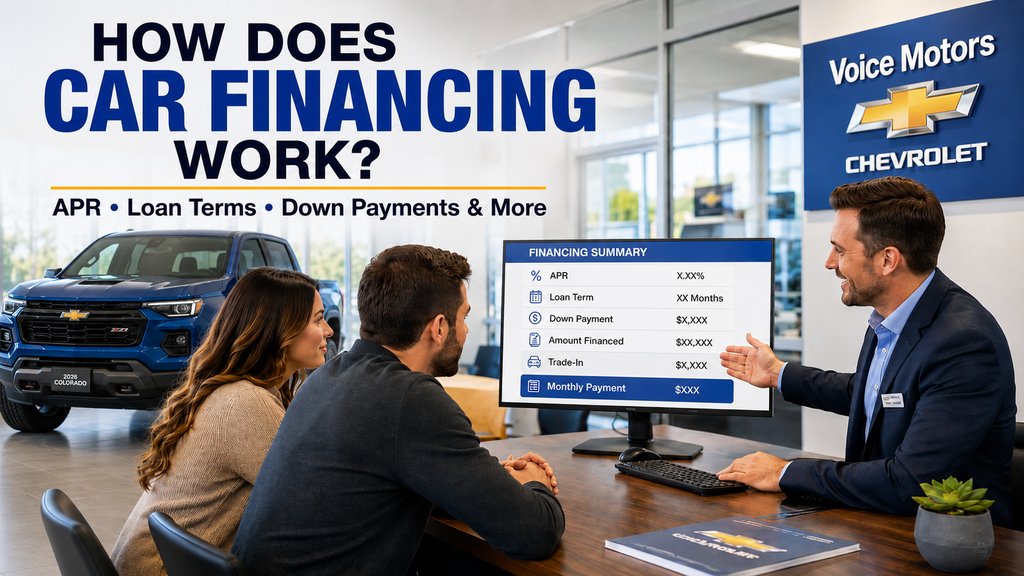
How Does Car Financing Work? APR, Loan Terms, Down Payments & More
Reviewed by the Voice Motor Sales Finance Department in Kalkaska, Michigan
Car financing can make buying a new or used vehicle more manageable by allowing you to spread the cost over a period of time instead of paying the entire purchase price upfront.
But before focusing on a monthly payment, it helps to understand what actually goes into an auto loan. Terms such as APR, amount financed, down payment, loan term, trade equity, and finance charge all affect what you ultimately pay for the vehicle.
Whether you are buying your first vehicle or simply have not financed one in several years, this guide explains how car financing works and which numbers deserve the most attention before you sign.
What Does It Mean to Finance a Car?
Financing a vehicle means borrowing money to pay for some or all of the vehicle purchase and repaying that money over an agreed period of time.
Instead of paying the entire purchase price at once, you typically make a down payment, apply any available trade-in equity, and finance the remaining balance through a lender.
The lender may be a bank, credit union, manufacturer-affiliated finance company, or another financial institution.
If financing is approved, the loan or retail installment agreement establishes important terms including:
- The amount financed
- The annual percentage rate, or APR
- The length of the loan
- The monthly payment
- The finance charge
- The total amount of payments
Understanding how those numbers relate to one another can make it much easier to compare financing options.
What Is APR on a Car Loan?
APR stands for annual percentage rate. It represents the cost of borrowing expressed as an annual percentage and is one of the most important numbers to review when comparing auto financing.
Generally, a lower APR means a lower borrowing cost when the amount financed and loan term are otherwise the same.
The APR available to an individual buyer can depend on a variety of factors, including:
- Credit history
- Credit score and credit profile
- Income and existing financial obligations
- Amount financed
- Down payment
- Loan term
- Vehicle age and mileage
- Whether the vehicle is new or used
- Individual lender requirements
Advertised rates may also have specific eligibility requirements, so the rate available to one shopper may not be the same rate available to another.
APR vs. Interest Rate: Are They the Same?
The terms are related, but they are not always identical.
The interest rate generally represents the rate charged for borrowing the principal. APR is designed to provide a broader measure of the cost of credit and may incorporate certain finance charges in addition to interest.
When comparing financing offers, APR is therefore an important number to review alongside the monthly payment, amount financed, loan term, and total cost.
What Is the Amount Financed?
The amount financed is the amount of credit being provided for the transaction after applicable components of the deal are taken into account.
Several things can affect how much you ultimately need to finance, including:
- The vehicle selling price
- Your down payment
- Trade-in value
- Any remaining payoff on your trade
- Applicable taxes and government fees
- Optional products you choose to purchase
- Rebates or incentives that may apply
Reducing the amount financed generally reduces the amount of money on which financing costs are calculated.
How Does a Down Payment Work?
A down payment is money you contribute toward the vehicle purchase rather than financing that portion of the transaction.
For example, if you purchase a vehicle and contribute cash upfront, that money can reduce the amount that needs to be borrowed.
A larger down payment may:
- Reduce the amount financed
- Lower the monthly payment
- Reduce total financing costs
- Increase your initial equity in the vehicle
However, there is no single down-payment amount that is right for every buyer. It is also important to consider how much cash you want to keep available for emergencies and other financial priorities.
Can Your Trade-In Be Used as a Down Payment?
If your current vehicle has positive equity, that value can generally be applied toward your next vehicle purchase.
Positive equity means the vehicle’s trade value is greater than the amount you still owe on it.
For example, if your vehicle is worth more than its current loan payoff, the difference can help reduce the amount that must be covered by additional cash or financing.
If you owe more than the vehicle is worth, you have what is commonly called negative equity. That changes the financing calculation and should be reviewed carefully when considering your next purchase.
You can begin by using the
Voice Motor Sales trade appraisal tool
to provide information about your current vehicle.
What Is a Car Loan Term?
The loan term is the amount of time scheduled for repayment of the vehicle loan.
Auto financing may be available with different term lengths depending on the lender, vehicle, amount financed, credit profile, and other factors.
The loan term has a significant effect on both the monthly payment and the total financing cost.
Shorter vs. Longer Car Loans
Shorter Loan Term
A shorter loan term generally means the borrowed amount is repaid over fewer months.
With the same amount financed and APR, a shorter term will usually result in a higher monthly payment but less total interest paid over the life of the loan.
Longer Loan Term
Extending repayment over more months can reduce the monthly payment, but it may increase the total amount of interest paid.
This is why choosing financing based only on the lowest monthly payment can be misleading.
A payment may look more affordable because the same balance has been spread over a longer period of time.
How Is a Monthly Car Payment Determined?
Your monthly payment is influenced primarily by the amount financed, APR, and loan term.
In simplified terms:
- Financing more money generally increases the payment.
- A higher APR generally increases the cost of financing.
- A shorter term generally increases the monthly payment but may reduce total interest.
- A longer term generally lowers the monthly payment but may increase total interest.
- A larger down payment or positive trade equity can reduce the amount financed.
Because several variables work together, two vehicles with similar prices can still produce different monthly payments.
Why You Should Look Beyond the Monthly Payment
Monthly payment matters because it has to fit comfortably into your budget. But it should not be the only number you consider.
When reviewing a financing option, pay attention to:
- Vehicle selling price
- Down payment
- Trade value and payoff
- Amount financed
- APR
- Loan term
- Monthly payment
- Finance charge
- Total amount of payments
Looking at the entire transaction helps you understand whether a lower monthly payment is coming from a lower borrowing cost, a larger down payment, or simply a longer loan term.
What Is a Finance Charge?
The finance charge represents the dollar cost of credit under the financing agreement.
It is useful because APR expresses borrowing cost as a percentage, while the finance charge helps show that cost in dollars.
Reviewing both can provide a clearer understanding of what financing the vehicle will cost over the scheduled term.
Does Your Credit Score Determine Your Car Loan?
Credit can play an important role in financing, but there is not one universal credit score that guarantees approval or a particular rate.
Lenders can evaluate multiple factors when reviewing an application, including credit history, income, existing debt obligations, amount financed, vehicle information, down payment, and other underwriting criteria.
Two buyers with similar credit scores could potentially receive different financing decisions because their complete financial profiles are different.
That is why it is better to think of your credit score as one part of the financing decision rather than the only factor.
Does Financing a Car Build Credit?
An auto loan can become part of your credit history, and payment activity may be reported to credit bureaus depending on the lender.
However, taking out a loan solely for the purpose of trying to improve a credit score is not necessarily appropriate for everyone.
If you finance a vehicle, the priority should be choosing a payment and loan structure that fits your financial situation and making required payments according to the agreement.
Should You Get Pre-Approved Before Shopping?
Completing a financing application before selecting a vehicle can help you begin exploring the financing options that may be available to you.
It can also give you a better idea of what information a lender may require and help you think about your overall vehicle budget before making a final decision.
Voice Motor Sales offers an
online vehicle financing application
for shoppers who want to begin the process before visiting the dealership.
Submission of an application does not guarantee approval, a particular APR, loan amount, payment, or financing term. Financing is subject to credit approval and lender requirements.
Can You Finance a New and Used Vehicle?
Financing may be available for both new and pre-owned vehicles.
The financing terms available can differ based on whether a vehicle is new or used, as well as its model year, mileage, value, amount financed, and lender criteria.
New vehicles may occasionally have manufacturer-sponsored financing offers for qualified buyers. Those programs can change and may include specific models, terms, eligibility requirements, and expiration dates.
Used-vehicle financing is also widely available, although rates and maximum terms can vary based on the vehicle and lender.
Should You Choose a Vehicle Based on the Payment?
A target monthly payment can be useful for budgeting, but starting with the payment alone can make it harder to understand the total transaction.
A better approach is to consider:
- How much vehicle you comfortably want to purchase
- How much you want to put down
- Whether you have a trade-in
- How much you are comfortable financing
- The APR and loan term
- The resulting monthly payment
- Your expected insurance, fuel, maintenance, and ownership costs
This gives you a more complete picture of affordability than the payment by itself.
How Does Negative Equity Affect Car Financing?
Negative equity occurs when the amount owed on your current vehicle is greater than its trade-in value.
For example, if your current loan payoff exceeds what the vehicle is worth, that difference must be addressed as part of the transaction.
Depending on the transaction and lender requirements, some or all of that amount may need to be paid separately or may potentially be included in the financing for another vehicle.
Including negative equity in a new loan increases the amount financed, which can affect the payment, loan-to-value relationship, financing cost, and approval requirements.
If you have negative equity, reviewing the numbers carefully before replacing your current vehicle is particularly important.
What Should You Bring When Applying for Vehicle Financing?
Exact documentation requirements can vary, but it is helpful to be prepared with accurate information when applying.
Depending on the lender and transaction, you may be asked for information relating to:
- Your identity
- Current address
- Employment
- Income
- Existing financial obligations
- Vehicle trade-in and payoff information
- Insurance
Additional documentation may be requested depending on the individual application.
What Our Finance Team Recommends
At Voice Motor Sales, we recommend looking at the complete financing structure rather than concentrating on one number.
Before making a decision, make sure you understand:
- What the vehicle costs
- What your trade is worth
- How much you still owe on your trade, if anything
- How much cash you are putting down
- How much you are financing
- Your APR
- Your loan term
- Your monthly payment
- Your total financing cost
If something in the financing agreement is unclear, ask questions before signing. Understanding the numbers is an important part of choosing a vehicle and financing arrangement that fits your needs.
Car Financing for Northern Michigan Drivers
Vehicle affordability is about more than the purchase price, particularly in Northern Michigan.
Depending on your driving habits, you may also need to consider fuel costs, insurance, maintenance, tires, winter driving capability, towing requirements, commuting distance, and how long you expect to keep the vehicle.
A driver commuting between Kalkaska and Traverse City may have different priorities than someone using a truck for towing, working on rural property, or regularly traveling seasonal roads.
Choosing the right vehicle first and then evaluating a financing structure that fits your overall budget can help create a better long-term ownership experience.
Finance vs. Paying Cash: Which Is Better?
Financing is not automatically better than paying cash, and paying cash is not automatically better than financing.
Cash eliminates auto-loan interest and monthly loan payments, while financing can allow a buyer to preserve more available cash and spread the vehicle cost over time.
We cover that decision in more detail in our guide:
Financing vs. Paying Cash for a Used Car: Which Is Better?
Explore Vehicle Financing at Voice Motor Sales
If you are shopping for a new or used vehicle, the finance team at Voice Motor Sales in Kalkaska can help you review available financing options and understand the numbers involved in your transaction.
You can:
-
Start an online financing application
-
Get started with a trade appraisal
-
Browse new vehicle inventory
-
Browse used vehicle inventory
-
Visit the Voice Motor Sales Finance Department
Financing availability, rates, terms, down payment requirements, incentives, and approval are subject to applicable lender requirements, program eligibility, and credit approval.
Helpful Vehicle Financing Resources
Frequently Asked Questions About Car Financing
How does financing a car work?
Vehicle financing allows you to borrow money toward a vehicle purchase and repay the amount over an agreed loan term. Your payment and total borrowing cost depend on factors such as the amount financed, APR, term length, down payment, and applicable lender requirements.
What does APR mean when financing a car?
APR stands for annual percentage rate and provides a standardized way to express the annual cost of borrowing. It is an important number to compare when evaluating vehicle financing options.
Does a larger down payment lower a car payment?
A larger down payment generally reduces the amount that needs to be financed. With other financing terms remaining the same, financing a smaller amount generally results in a lower monthly payment and lower total financing costs.
Is a longer car loan better because the payment is lower?
Not necessarily. A longer loan term can reduce the monthly payment by spreading repayment over more months, but it can also increase the total amount of interest paid. Compare both the monthly payment and total financing cost.
Can I use my trade-in toward a down payment?
If your trade-in has positive equity, that value can generally be applied toward the vehicle transaction and may reduce the amount you need to pay in cash or finance.
What if I owe more on my trade than it is worth?
When your loan payoff is greater than the vehicle’s trade value, the difference is called negative equity. How that amount is handled depends on the transaction and lender requirements, and including it in another loan can increase the amount financed.
Do I need perfect credit to finance a vehicle?
There is no universal credit score that guarantees or prevents vehicle financing. Lenders may consider credit history along with income, debt obligations, down payment, vehicle information, amount financed, and other underwriting criteria.
Should I get pre-approved before buying a car?
Beginning the financing process before selecting a vehicle can help you explore potential financing options and think about your budget. Final approval, APR, loan amount, and terms remain subject to lender requirements and credit approval.
Where can I apply for car financing near Kalkaska, Michigan?
Shoppers can begin a vehicle financing application online through Voice Motor Sales in Kalkaska, Michigan. Voice Motor Sales serves vehicle shoppers from Kalkaska and surrounding Northern Michigan communities.

