Blog / New Vehicles

When Is the Best Time to Buy a Car?

When Is the Best Time to Buy a Car?

When Is the Best Time to Buy a Car?

By Voice Motor Sales in Kalkaska, Michigan

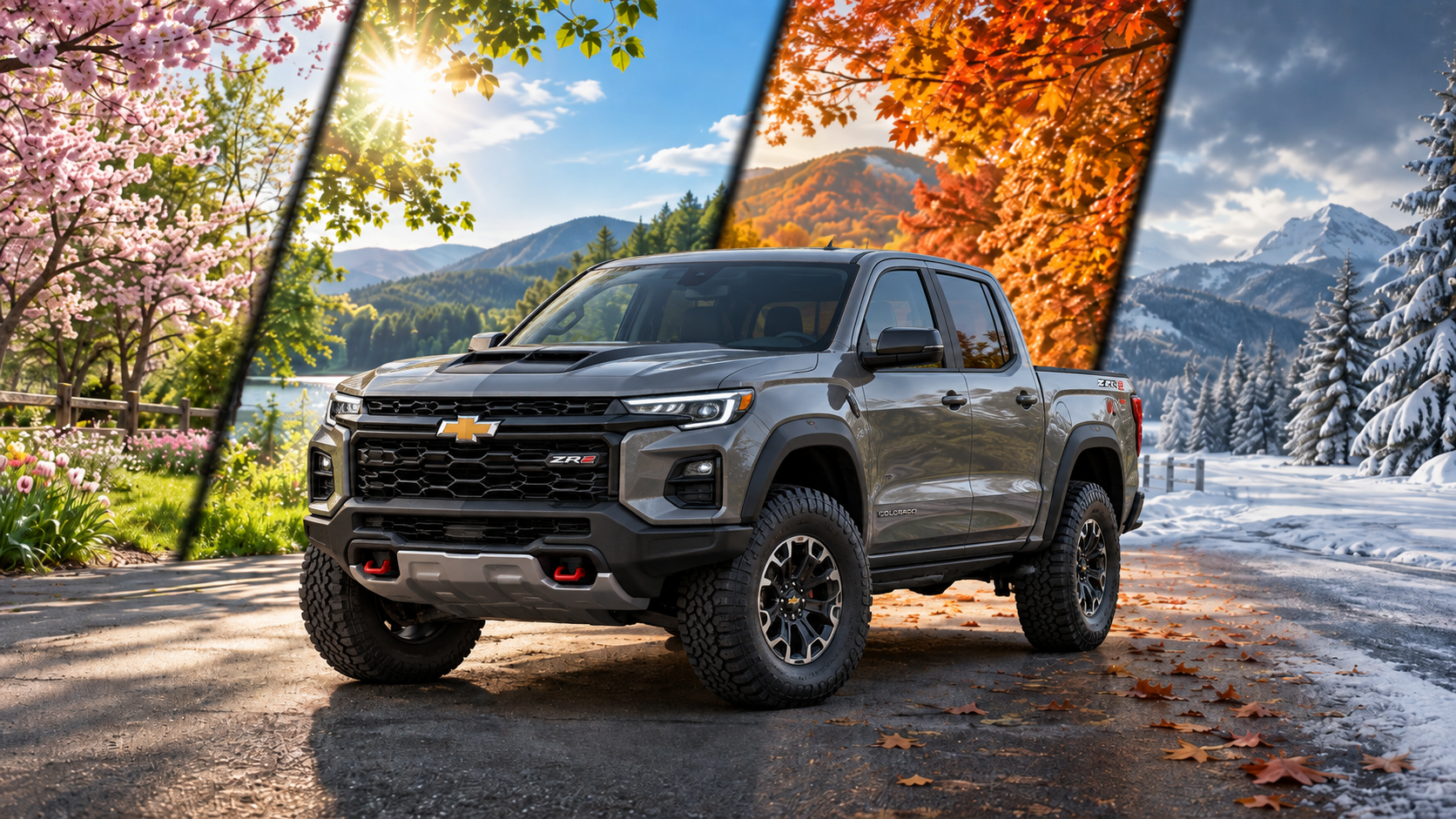
Is December the best month to buy a car? Should you wait for a holiday sale, shop at the end of the month, or buy before the next model year arrives?

The best time to buy a car is when the right vehicle, an affordable total cost, and your transportation needs line up. Certain shopping periods can create opportunities, but no date guarantees the lowest price.

For drivers in Kalkaska and throughout Northern Michigan, a little preparation can be more useful than trying to predict the perfect sale. Here is how to decide when to shop and when waiting may make sense.

Is There a Best Month to Buy a Car?

Late-year shopping is worth considering, particularly when dealerships have outgoing model-year vehicles available. However, pricing depends on the specific vehicle, remaining inventory, and applicable manufacturer programs.

Car and Driver identifies the end of the calendar year and model-year transitions as periods to consider. Treat those as shopping opportunities, not promises that every vehicle will cost less.

Start by identifying the vehicle you want and comparing actual purchase figures. A good fit available today may be more valuable than an uncertain future discount.

Does Buying at the End of the Month Help?

Sometimes. Dealership sales goals and inventory priorities can influence offers, but shoppers cannot assume every dealership or vehicle is in the same situation.

If you want to compare an end-of-month opportunity, research and test-drive vehicles earlier. That gives you time to review pricing without making a rushed decision.

Confirm the expiration date of any offer. Do not assume it ends on the last calendar day or will continue into the following month.

Should You Wait for a Holiday Sale?

Holiday events can be a useful reminder to check available offers. However, the sale name does not tell you whether the deal fits your situation.

When reviewing an advertised offer, ask:

  • Which vehicles qualify?
  • What eligibility requirements apply?
  • Can the advertised incentives be combined?
  • What is the complete purchase price?
  • When does the offer expire?

Keep the comparison consistent. A lower payment on a longer loan is different from a lower vehicle price. The FTC recommends evaluating the total financing cost, including the APR and loan term, rather than concentrating only on the monthly payment.

Is an Outgoing Model Year a Better Buy?

An outgoing model-year vehicle may offer an attractive opportunity when newer models arrive. The tradeoff is selection: the exact color, trim, or equipment package you want may no longer be available.

Compare the actual vehicles side by side. Consider differences in features, purchase price, available financing, and how long you expect to keep the vehicle.

Model-year changes do not happen on one universal date. Edmunds explains that model introductions vary, making vehicle-specific research more useful than assuming every new model arrives in the fall.

When Is the Best Time to Buy a Used Car?

With a used vehicle, focus closely on the individual car. Two vehicles from the same model year can differ substantially in mileage, condition, equipment, and maintenance history.

Before deciding that a particular listing is a good opportunity, compare:

  • The asking price with similar vehicles
  • Mileage and overall condition
  • Available vehicle-history and maintenance information
  • Features that matter to your household
  • Financing terms and expected ownership expenses

Begin with our current used vehicle inventory. Give yourself enough time to evaluate a vehicle carefully without assuming the same combination will remain available indefinitely.

Should You Buy Before Winter in Northern Michigan?

If you already expect to replace your vehicle, shopping before winter can give you time to compare options before transportation becomes urgent.

Think about your actual routine: commuting between Kalkaska and Traverse City, driving rural roads, carrying family members, or traveling for work. Consider tires, ground clearance, visibility, and overall vehicle condition alongside drivetrain choices.

This is a planning advantage, not a claim that fall always brings lower prices. The goal is to avoid having an unexpected breakdown make the decision for you.

When Does Waiting Make Sense?

Waiting may be worthwhile when your current vehicle meets your needs and additional time would improve your financial position or help you clarify what to buy.

You might use that time to build a down payment, compare insurance costs, review your credit reports, or narrow your must-have features. Set a specific goal, such as saving a certain amount, rather than waiting indefinitely for an undefined “better deal.”

When Might Buying Now Make More Sense?

Consider moving forward when you have found a suitable vehicle, understand the complete transaction, and can comfortably manage the cost.

Also consider the expense of waiting. Recurring repairs, rental transportation, or missed work can affect the comparison. Estimate those costs without assuming that every repair means your current vehicle should be replaced.

What to Check Before You Decide

  1. Vehicle fit: Does it meet your everyday needs?
  2. Total price: Have you reviewed an itemized purchase amount?
  3. Trade-in: Do you know its value and any remaining payoff?
  4. Financing: Have you compared the APR, term, and total payments?
  5. Cash reserves: Will you retain money for other expenses?
  6. Timing: Is there a practical reason to buy or wait?

Explore Your Options at Voice Motor Sales

You do not need to choose a purchase date before starting your research. At Voice Motor Sales in Kalkaska, begin by browsing new Chevrolet vehicles, exploring used inventory, or requesting an online trade appraisal.

Visit our finance department page to learn about financing options, or contact Voice Motor Sales with questions about a vehicle.

Frequently Asked Questions

Is December always the cheapest month to buy a car?

No. December can provide shopping opportunities, but prices depend on the vehicle, inventory, and available offers. Compare actual purchase figures rather than assuming a particular month guarantees savings.

Should I wait for the next model year?

Compare the features and cost of the incoming model with available outgoing models. Waiting may make sense if a specific change matters to you; an available vehicle may already meet your needs.

Is there a best day of the week to buy a car?

No weekday guarantees the lowest price. Schedule a visit when you have enough time to test-drive vehicles, ask questions, and review the purchase details without rushing.

Is a holiday sale automatically a better deal?

No. Compare the complete price, eligibility requirements, financing terms, and offer expiration. A promotional event alone does not establish which option is best for your budget.

Vehicle availability and offers can change. Financing, incentives, rates, and terms are subject to applicable eligibility requirements and credit approval.

Best Time to Buy a Car in Michigan | Voice Motor Sales
Posted in:

Related Posts

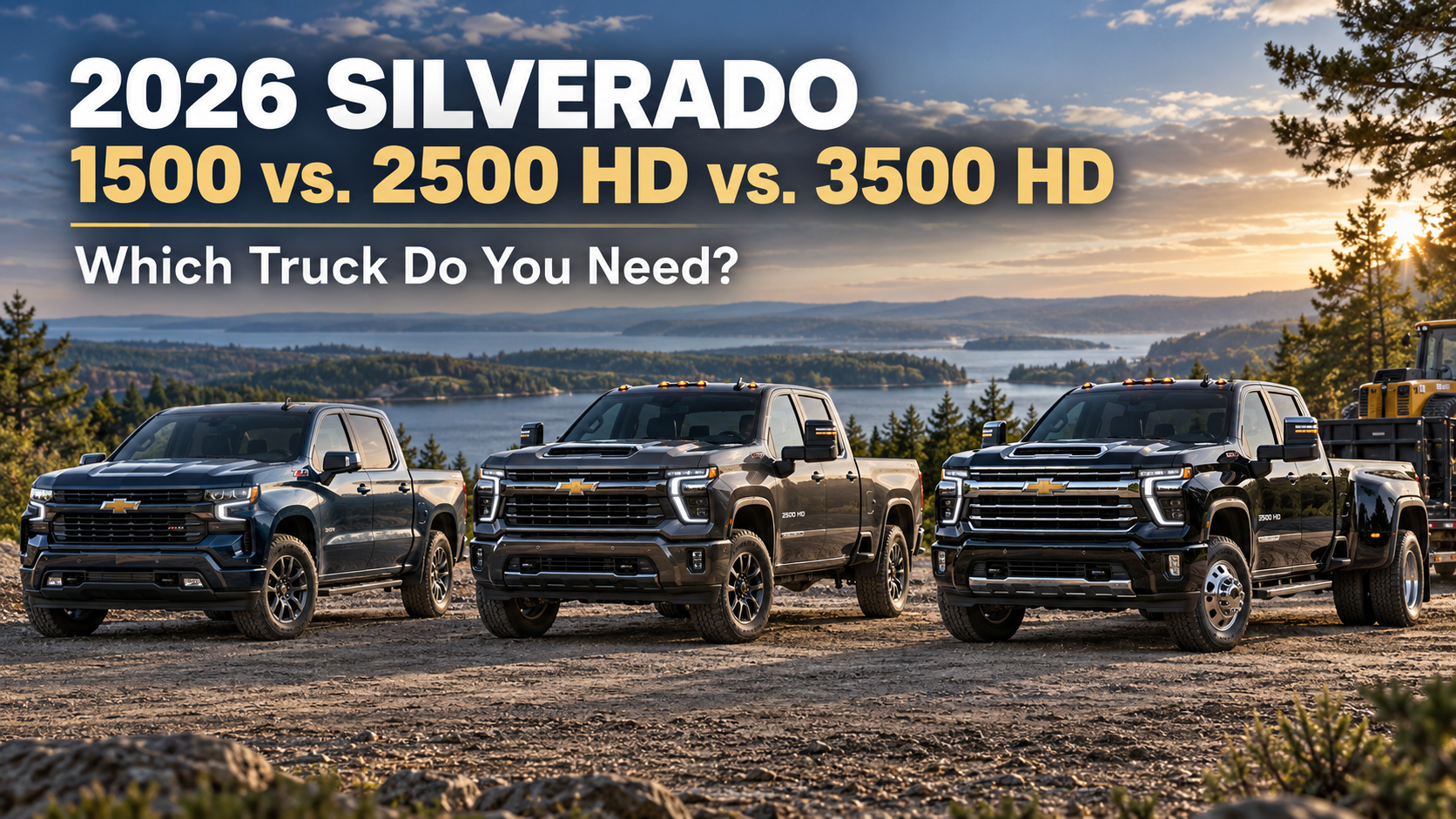
Chevy Silverado 1500 vs. 2500 HD vs. 3500 HD

2026 Chevy Silverado 1500 vs. 2500 HD vs. 3500 HD: Which Truck Do You Need?

2026 Chevy Silverado 1500 vs. 2500 HD vs. 3500 HD: Which Truck Do You Need? Reviewed by the Voice Motor Sales Sales Department in Kalkaska, Michigan If you know you want a Chevrolet Silverado but are trying to decide between a Silverado 1500, Silverado 2500 HD, and Silverado 3500 HD, the most important question is not simply which truck is bigger. The better question is: What do you actually need your truck to do? For many drivers, the Silverado 1500 provides plenty of capability while remaining comfortable and practical for everyday use. The Silverado 2500 HD moves into serious heavy-duty towing and hauling territory. The Silverado 3500 HD goes farther, offering substantially greater payload capability and available dual rear wheels for some of Chevrolet's heaviest towing applications. The right choice depends on what you tow, how much weight you carry in the truck, how often you tow, and how much heavy-duty capability you really need. Here is a closer look at the 2026 Chevrolet Silverado 1500 vs. 2500 HD vs. 3500 HD and where each truck fits. Silverado 1500 vs. 2500 HD vs. 3500 HD at a Glance 2026 Chevrolet Silverado Capability Comparison Specification Silverado 1500 Silverado 2500 HD Silverado 3500 HD Truck Class Light-Duty / Half-Ton Heavy-Duty / Three-Quarter-Ton Heavy-Duty / One-Ton Max Available Towing 13,300 lbs. 22,420 lbs. 36,000 lbs. Max Available Payload 2,260 lbs. 4,101 lbs. 7,237 lbs. Gas Engine Choices TurboMax, 5.3L V8, 6.2L V8 6.6L V8 6.6L V8 Diesel Engine 3.0L Duramax Turbo-Diesel 6.6L Duramax Turbo-Diesel V8 6.6L Duramax Turbo-Diesel V8 Dual Rear Wheels Available No No Yes Typical Focus Everyday use, moderate towing and hauling Heavy towing and hauling Maximum towing, payload and heavy-duty work Maximum ratings require specific configurations and equipment. The towing and payload capacity of an individual truck may be considerably different from the maximum figures shown above. Always verify the ratings of the specific truck and trailer before towing. What Do 1500, 2500, and 3500 Actually Mean? Silverado's 1500, 2500, and 3500 designations identify different levels of truck capability. They are commonly associated with traditional truck classifications: Silverado 1500: commonly called a half-ton pickup Silverado 2500 HD: commonly called a three-quarter-ton pickup Silverado 3500 HD: commonly called a one-ton pickup Those names are historical classifications. They do not mean that a Silverado 1500 can only carry 1,000 pounds or a Silverado 3500 can only carry 2,000 pounds. Modern trucks can carry considerably more than those old classifications suggest. 2026 Silverado 1500: The Everyday Full-Size Pickup The Silverado 1500 is Chevrolet's light-duty full-size pickup and will provide all the truck many drivers ever need. It combines significant towing and payload capability with a wider range of engine choices and the everyday driving characteristics many people want from a personal vehicle. Chevrolet lists a maximum available towing capacity of 13,300 pounds and maximum available payload of 2,260 pounds for the 2026 Silverado 1500 when properly configured. 2026 Silverado 1500 Engine Choices One advantage of the Silverado 1500 is the variety of available powertrains. TurboMax 310 horsepower 430 lb.-ft. of torque 8-speed automatic transmission 5.3L EcoTec3 V8 355 horsepower 383 lb.-ft. of torque 10-speed automatic transmission 6.2L EcoTec3 V8 420 horsepower 460 lb.-ft. of torque 10-speed automatic transmission 3.0L Duramax Turbo-Diesel 305 horsepower 495 lb.-ft. of torque 10-speed automatic transmission Available towing capability up to 13,300 pounds when properly equipped Who Should Consider a Silverado 1500? A Silverado 1500 may make sense for someone who uses a truck as both an everyday vehicle and a tow or work vehicle. Typical uses might include: Daily commuting Home improvement projects Hauling ATVs or side-by-sides Pulling many boats Pulling utility trailers Towing appropriately sized travel trailers Carrying recreational equipment Property maintenance Light commercial work The important qualifier is trailer weight. A boat, camper, or equipment trailer can range dramatically in size and loaded weight, so the actual truck configuration still needs to be matched to the specific trailer. Why Choose a 1500 Instead of an HD? More capability is not automatically better if you do not need it. Compared with an HD truck, a Silverado 1500 can offer advantages for someone who spends most of their time driving without a heavy trailer. Depending on configuration, those advantages can include: Easier everyday maneuverability More powertrain choices Potentially better fuel economy A more everyday-oriented ride More than enough towing capability for many recreational trailers If your loaded trailer comfortably fits within the truck's ratings and you do not need HD-level payload, moving to a 2500 or 3500 solely because it is larger may not be necessary. 2026 Silverado 2500 HD: The Step Into Heavy-Duty Capability Silverado 2500 HD is where the lineup makes a major jump in towing, payload, engine size, chassis capability, and overall heavy-duty construction. Chevrolet lists a maximum available towing capacity of 22,420 pounds for the 2026 Silverado 2500 HD. Maximum available payload increases to 4,101 pounds. That difference is why the 2500 HD becomes particularly important for drivers towing larger campers, heavy equipment trailers, larger enclosed trailers, and other loads that can begin to push beyond the practical limits of a light-duty pickup. 2026 Silverado 2500 HD Engine Choices Rather than the four-engine lineup found in the 1500, Silverado HD focuses on two 6.6-liter V8 powertrains. 6.6L Gas V8 401 horsepower 464 lb.-ft. of torque 10-speed Allison automatic transmission 6.6L Duramax Turbo-Diesel V8 470 horsepower 975 lb.-ft. of torque 10-speed Allison automatic transmission Both engines provide substantially different characteristics from the light-duty Silverado powertrain lineup. Gas vs. Diesel in a Silverado 2500 HD Choosing between the 6.6L gasoline V8 and Duramax diesel deserves its own consideration. The gas engine can be attractive to owners who want HD chassis and payload capability without necessarily needing maximum diesel torque. The Duramax may be particularly appealing to drivers who frequently tow heavier trailers, travel long distances with a trailer, or want the HD lineup's highest available torque. Diesel also adds purchase cost and changes maintenance and operating considerations, so engine selection should be based on how the truck will actually be used rather than simply choosing the engine with the larger torque number. Who Should Consider a Silverado 2500 HD? Silverado 2500 HD becomes especially relevant when towing and payload are regular parts of the truck's job. Possible uses include: Larger travel trailers Some fifth-wheel trailers Heavy equipment trailers Construction trailers Farm use Commercial work Snow and property-management equipment Heavy loads in the bed Frequent long-distance towing Again, the specific loaded trailer weight and the exact truck ratings should determine whether a particular 2500 HD configuration is appropriate. 2026 Silverado 3500 HD: Maximum Silverado Pickup Capability The Silverado 3500 HD takes the basic heavy-duty formula another step. Chevrolet lists maximum available towing of 36,000 pounds and maximum available payload of 7,237 pounds for the 2026 Silverado 3500 HD when properly configured. The 3500 HD is also the Silverado model that introduces an important additional option: dual rear wheels. What Is a Dually? A dual-rear-wheel truck, commonly called a dually, has two rear tires on each side instead of one. A 3500 HD can be configured as either: SRW: Single rear wheel DRW: Dual rear wheel Dual rear wheels allow certain 3500 HD configurations to handle substantially greater rear-axle and payload demands, which becomes especially important with heavy gooseneck and fifth-wheel trailers. The tradeoff is that a dually is wider and is generally more truck than a driver needs if heavy payload and towing are not part of its regular job. 2500 vs. 3500: What's the Real Difference? This is often the harder comparison. The Silverado 2500 HD and 3500 HD offer the same two primary engines: 6.6L gasoline V8 6.6L Duramax Turbo-Diesel V8 So moving from a 2500 to a 3500 does not necessarily mean moving to a more powerful engine. The major difference is the truck's ability to support more weight. The 3500 HD can offer: Higher GVWR depending on configuration Higher maximum payload Greater maximum towing capability Available dual rear wheels Greater capability for high trailer pin or tongue weight That last point is particularly important. Don't Compare Trucks Using Towing Capacity Alone Maximum towing capacity gets most of the attention in truck advertising, but it is not the only number that matters. In some situations, payload capacity can be the limiting factor before maximum trailer weight is reached. Payload can include weight from: Driver Passengers Cargo in the cab Cargo in the bed Accessories Trailer tongue weight or pin weight That is why two trucks that can both technically pull a particular trailer may not have the same ability to carry everything associated with that trailer. Why Payload Matters With a Fifth-Wheel Camper Fifth-wheel trailers are a good example. A portion of the trailer's weight is supported directly by the truck through the hitch mounted in the bed. That weight counts against the truck's available payload. Once passengers, a hitch, tools, cargo, and other equipment are added, a truck can approach its payload rating even when the trailer itself is technically below the truck's advertised maximum towing capacity. This is one of the main reasons someone shopping for a large fifth-wheel camper may end up comparing a 2500 HD with a 3500 HD rather than looking only at maximum tow ratings. Silverado 1500 vs. 2500 for Towing The choice between a 1500 and 2500 often comes down to how heavy the trailer is and how frequently you tow it. Silverado 1500 offers up to: 13,300 pounds maximum available towing 2,260 pounds maximum available payload Silverado 2500 HD increases those maximums to: 22,420 pounds maximum available towing 4,101 pounds maximum available payload That is a substantial step. If your trailer falls comfortably within a properly equipped Silverado 1500's ratings, the 1500 may provide the capability you need without moving into an HD truck. If your trailer or payload begins approaching light-duty limits—or if heavy towing will be a frequent part of the truck's life—the 2500 HD deserves serious consideration. Silverado 2500 vs. 3500 for Towing Moving from the 2500 HD to the 3500 HD becomes increasingly important as trailer and payload requirements grow. Maximum available ratings are: 2500 HD: up to 22,420 pounds towing and 4,101 pounds payload 3500 HD: up to 36,000 pounds towing and 7,237 pounds payload For a shopper considering a large fifth-wheel, gooseneck, commercial trailer, or heavy in-bed load, that increase in payload can be just as important as the higher towing number. Do You Need a 3500 if You Don't Want a Dually? Not necessarily—but it is worth knowing that the 3500 HD is also available in single-rear-wheel configurations. Someone may choose a single-rear-wheel 3500 HD because they need more payload or GVWR than an otherwise similar 2500 HD can provide without needing the width or maximum capacity of a dually. The exact ratings of the trucks you are comparing become especially important here because cab, bed, drivetrain, engine, trim, and equipment can all affect the final numbers. Which Silverado Is Better for Everyday Driving? If towing and payload requirements do not dictate an HD truck, the Silverado 1500 is typically the more everyday-oriented choice. It is designed to balance truck capability with commuting, family use, recreational driving, and general transportation. Silverado 2500 HD and 3500 HD are physically larger, heavier-duty vehicles designed around greater workloads. That extra capability can be extremely valuable when you need it—but it should serve a purpose. Which Silverado Is Better for a Camper? It depends entirely on the camper. "Camper" can describe anything from a relatively light travel trailer to an extremely large fifth-wheel. When shopping for a truck to tow a camper, determine: The camper's loaded weight Its tongue or pin weight The weight of your hitch The number of passengers Cargo carried in the truck Whether you expect to add equipment later Then compare those figures with the ratings of the exact truck. Do not choose a tow vehicle based only on the trailer's advertised dry weight. Which Silverado Is Better for Towing a Boat? Boat trailers also vary enormously. Many recreational boats can fall comfortably within Silverado 1500 capability, while larger boats and trailers may make an HD truck more appropriate. Remember to consider the complete loaded trailer weight, including: Boat Trailer Fuel Batteries Fishing equipment Coolers Other gear carried aboard Which Silverado Is Better for Work? All three can be work trucks. The difference is the type of work. Silverado 1500 Can be a strong choice for trades, property maintenance, general contracting, sales, site visits, and jobs that require a truck without continuously carrying extremely heavy loads. Silverado 2500 HD Becomes attractive when heavier trailers, equipment, tools, payload, or frequent towing are normal parts of the job. Silverado 3500 HD Is designed for users whose work demands maximum pickup-level payload and towing capability, including certain agriculture, construction, equipment, and commercial applications. 1500 vs. 2500 vs. 3500 for Northern Michigan Silverado owners throughout Northern Michigan use their trucks in very different ways. Around Kalkaska, Traverse City, Grayling, Cadillac, Lake City, Mancelona, and surrounding communities, that can include: Towing boats Pulling campers Moving ATVs and side-by-sides Hauling firewood Property maintenance Construction work Agricultural use Pulling equipment trailers Snow removal Long-distance recreational towing A Silverado 1500 may be ideal for someone pulling a recreational trailer on the weekends while using the truck every day. Someone regularly hauling equipment or towing a larger camper may benefit from the additional capability of a 2500 HD. A buyer pulling a large fifth-wheel or gooseneck trailer with substantial pin weight may need the higher payload and available dual-rear-wheel capability of a 3500 HD. Should You Buy More Truck Than You Currently Need? Some additional capacity can be useful, particularly if you expect your trailer or workload to grow in the future. But there is also little reason to buy significantly more truck than your actual needs require. The goal is to have sufficient capacity for your real loaded trailer and payload while still choosing a truck that works well for the rest of your driving. Use the Door-Jamb Payload Label Advertised maximum ratings are useful for comparing truck families, but the most important numbers belong to the specific truck you are buying. Payload varies based on equipment and configuration. Adding options and equipment adds vehicle weight, which can change how much capacity remains for passengers, cargo, and trailer weight. Check the certification and payload labels on the actual vehicle and review Chevrolet's trailering information before towing. Don't Forget Trailer Weight After Loading Another common mistake is comparing a truck's towing rating with an empty trailer weight. Once a trailer is loaded with: Water Fuel Food Tools Camping equipment ATVs or recreational vehicles Construction materials Other cargo its actual weight can be substantially different. Match the truck to the trailer as it will actually be used. Quick Guide: Which Silverado Should You Look At? Start With a Silverado 1500 If: You want a truck that will also be an everyday vehicle Your towing needs fit comfortably within a properly equipped 1500's ratings You want the widest selection of engine choices You tow recreationally rather than routinely pulling extremely heavy loads You do not need heavy-duty payload capacity Move Up to a Silverado 2500 HD If: Your trailer is too heavy for the 1500 configuration you are considering You need substantially more payload You tow heavy loads regularly You want the available 6.6L Duramax diesel You use the truck for demanding work or recreational towing Consider a Silverado 3500 HD If: You need more payload than a 2500 HD provides You pull a large fifth-wheel or gooseneck trailer High pin weight is an important consideration You need maximum Silverado pickup towing capability You need or want a dual-rear-wheel configuration Your commercial or recreational workload requires one-ton capability What Our Sales Team Recommends At Voice Motor Sales, we recommend starting with the trailer and workload instead of starting with the truck badge. Before deciding between a Silverado 1500, 2500 HD, and 3500 HD, determine: What are you towing? What is its actual loaded weight? What is the tongue or pin weight? How many people will normally be in the truck? How much cargo will you carry? How frequently will you tow? Will your trailer get larger in the future? Do you want gasoline or diesel? Will the truck also be your everyday vehicle? Once those questions are answered, choosing between a 1500, 2500, and 3500 becomes much easier. Shop Chevrolet Silverado Trucks at Voice Motor Sales If you are comparing Silverado 1500, 2500 HD, and 3500 HD trucks in Northern Michigan, the team at Voice Motor Sales in Kalkaska can help you compare configurations based on how you actually plan to use the truck. You can browse current new Chevrolet inventory or contact Voice Motor Sales with questions about a specific Silverado. If you have a vehicle to trade, you can also begin with our online trade appraisal. Financing information is available through the Voice Motor Sales Finance Department. Looking Ahead to the Next-Generation Silverado 1500 Chevrolet has also announced a redesigned next-generation Silverado 1500 for the 2027 model year, including new 5.7L and 6.6L naturally aspirated V8 engines. If you are comparing buying a current truck with waiting for the next generation, read: 2027 Chevy Silverado 1500 Preview: Confirmed Trims, Engines, Redesign, and New Features 2027 Chevy Silverado 5.7L and 6.6L V8 Engines: What We Know So Far Frequently Asked Questions: Silverado 1500 vs. 2500 vs. 3500 What is the difference between a Silverado 1500 and 2500 HD? Silverado 1500 is Chevrolet's light-duty full-size pickup, while Silverado 2500 HD uses a heavier-duty chassis and substantially increases available towing and payload capability. For 2026, Chevrolet lists maximum available towing of 13,300 pounds for Silverado 1500 and 22,420 pounds for Silverado 2500 HD. What is the difference between a Silverado 2500 and 3500? Both trucks offer 6.6L gas and available 6.6L Duramax diesel V8 engines, but the Silverado 3500 HD can provide substantially higher payload and towing capacity. The 3500 HD is also available with dual rear wheels. How much can a 2026 Silverado 1500 tow? The 2026 Chevrolet Silverado 1500 offers up to 13,300 pounds of maximum available towing capacity when properly equipped. Actual capacity depends on engine, drivetrain, cab, bed, equipment, passengers, cargo, and other factors. How much can a 2026 Silverado 2500 HD tow? Chevrolet lists maximum available towing of up to 22,420 pounds for the 2026 Silverado 2500 HD when properly configured. How much can a 2026 Silverado 3500 HD tow? The 2026 Silverado 3500 HD offers maximum available towing of up to 36,000 pounds when properly configured. How much payload can a Silverado 1500 carry? Chevrolet lists maximum available payload of up to 2,260 pounds for the 2026 Silverado 1500. The exact payload of an individual truck varies by configuration and equipment. How much payload can a Silverado 2500 HD carry? The 2026 Silverado 2500 HD offers up to 4,101 pounds of maximum available payload depending on configuration. How much payload can a Silverado 3500 HD carry? The 2026 Silverado 3500 HD offers up to 7,237 pounds of maximum available payload depending on configuration. Do the Silverado 2500 and 3500 have the same engines? The 2026 Silverado 2500 HD and 3500 HD both offer a 6.6L gasoline V8 rated at 401 horsepower and 464 lb.-ft. of torque and an available 6.6L Duramax Turbo-Diesel V8 rated at 470 horsepower and 975 lb.-ft. of torque. Do I need a 2500 to tow a camper? Not necessarily. Many campers can be towed by a properly equipped Silverado 1500, while larger and heavier trailers may require a 2500 HD or 3500 HD. Use the camper's actual loaded weight, tongue or pin weight, and the ratings of the specific truck to determine what is required. Do I need a 3500 for a fifth-wheel camper? Not every fifth-wheel requires a 3500 HD, but payload and pin weight become especially important with larger fifth-wheel trailers. A 3500 HD may provide considerably more payload than a 2500 HD and is also available with dual rear wheels for higher-capacity applications. Can you get a Silverado 3500 without dual rear wheels? Yes. Silverado 3500 HD is available in both single-rear-wheel and dual-rear-wheel configurations depending on cab and bed configuration. Where can I compare Silverado 1500, 2500 HD, and 3500 HD trucks near Kalkaska, Michigan? Voice Motor Sales in Kalkaska is an authorized Chevrolet dealership serving truck shoppers throughout Northern Michigan. Current Chevrolet inventory can be viewed online, or shoppers can contact the sales department for help comparing Silverado configurations. Capability specifications are based on Chevrolet's published 2026 model information available at the time this article was written. Maximum trailering and payload figures require specific configurations and equipment. Ratings for an individual vehicle may vary based on engine, drivetrain, cab, bed, options, accessories, passengers, cargo, and trailer configuration. Always consult the vehicle's labels, owner's manual, trailering guide, and the ratings for the exact vehicle and trailer before towing. SEO TITLE: 2026 Silverado 1500 vs. 2500 HD vs. 3500 HD | Voice Motor Sales META DESCRIPTION: Compare the 2026 Chevy Silverado 1500, 2500 HD and 3500 HD. See towing, payload, engines, diesel options and which Silverado fits your truck needs. SUGGESTED URL SLUG: 2026-chevy-silverado-1500-vs-2500-hd-vs-3500-hd 2026 Silverado 1500 vs. 2500 HD vs. 3500 HD | Voice Motor Sales Update this URL if the CMS generates a different live article slug BLOGPOSTING SCHEMA { "@context": "https://schema.org", "@type": "BlogPosting", "@id": "https://www.voicemotors.com/blog/2026-chevy-silverado-1500-vs-2500-hd-vs-3500-hd#article", "mainEntityOfPage": { "@type": "WebPage", "@id": "https://www.voicemotors.com/blog/2026-chevy-silverado-1500-vs-2500-hd-vs-3500-hd" }, "headline": "2026 Chevy Silverado 1500 vs. 2500 HD vs. 3500 HD: Which Truck Do You Need?", "description": "A comparison of the 2026 Chevrolet Silverado 1500, Silverado 2500 HD and Silverado 3500 HD, including towing, payload, engines, diesel options, dual rear wheels and common use cases.", "datePublished": "2026-09-16", "dateModified": "2026-09-16", "author": { "@type": "Organization", "name": "Voice Motor Sales Sales Department", "url": "https://www.voicemotors.com/searchnew.aspx" }, "publisher": { "@type": "Organization", "@id": "https://www.voicemotors.com/#organization", "name": "Voice Motor Sales", "legalName": "Voice Motor Sales, Inc.", "url": "https://www.voicemotors.com/" }, "about": [ { "@type": "Thing", "name": "2026 Chevrolet Silverado 1500" }, { "@type": "Thing", "name": "2026 Chevrolet Silverado 2500 HD" }, { "@type": "Thing", "name": "2026 Chevrolet Silverado 3500 HD" }, { "@type": "Thing", "name": "Truck Towing Capacity" }, { "@type": "Thing", "name": "Truck Payload Capacity" }, { "@type": "Thing", "name": "Duramax Diesel" }, { "@type": "Place", "name": "Northern Michigan" } ] } BREADCRUMB SCHEMA { "@context": "https://schema.org", "@type": "BreadcrumbList", "itemListElement": [ { "@type": "ListItem", "position": 1, "name": "Voice Motor Sales", "item": "https://www.voicemotors.com/" }, { "@type": "ListItem", "position": 2, "name": "Blog", "item": "https://www.voicemotors.com/blog/" }, { "@type": "ListItem", "position": 3, "name": "2026 Silverado 1500 vs. 2500 HD vs. 3500 HD", "item": "https://www.voicemotors.com/blog/2026-chevy-silverado-1500-vs-2500-hd-vs-3500-hd" } ] } DEALERSHIP ENTITY SCHEMA { "@context": "https://schema.org", "@type": "AutoDealer", "@id": "https://www.voicemotors.com/#autodealer", "name": "Voice Motor Sales", "legalName": "Voice Motor Sales, Inc.", "url": "https://www.voicemotors.com/", "telephone": "+1-231-384-8377", "brand": { "@type": "Brand", "name": "Chevrolet" }, "address": { "@type": "PostalAddress", "streetAddress": "302 W Mile Rd NW", "addressLocality": "Kalkaska", "addressRegion": "MI", "postalCode": "49646", "addressCountry": "US" }, "areaServed": [ { "@type": "Place", "name": "Kalkaska, Michigan" }, { "@type": "Place", "name": "Traverse City, Michigan" }, { "@type": "Place", "name": "Grayling, Michigan" }, { "@type": "Place", "name": "Cadillac, Michigan" }, { "@type": "Place", "name": "Lake City, Michigan" }, { "@type": "Place", "name": "Mancelona, Michigan" }, { "@type": "Place", "name": "Northern Michigan" } ] }

Old vs. New

2027 Chevy Silverado 5.7L and 6.6L V8 Engines: What We Know So Far

2027 Chevy Silverado 5.7L and 6.6L V8 Engines: What We Know So Far Reviewed by the Voice Motor Sales Sales Department in Kalkaska, Michigan One of the biggest changes coming to the next-generation 2027 Chevrolet Silverado 1500 is happening under the hood. Chevrolet has officially confirmed two next-generation V8 engines for the redesigned Silverado: a new 5.7L V8 and a new 6.6L V8. These engines represent a major update to the Silverado's traditional V8 lineup and continue Chevrolet's long-running commitment to naturally aspirated V8 power in its full-size pickup. Chevrolet has not released every final specification yet, but there is already enough confirmed information to give truck shoppers a good idea of what is changing and why the new engines are worth watching. What Engines Will the 2027 Silverado 1500 Offer? Chevrolet has confirmed that the next-generation 2027 Silverado 1500 will continue to offer four powertrain choices. Enhanced 2.7L TurboMax four-cylinder 3.0L Duramax Turbo-Diesel Next-generation 5.7L V8 Next-generation 6.6L V8 The two V8s are the biggest powertrain news for the new generation, while the TurboMax and Duramax continue to provide alternatives for shoppers with different priorities. Chevrolet has also confirmed that the enhanced TurboMax will now be paired with a 10-speed automatic transmission. The 5.7L V8 Returns to the Silverado The new 5.7L V8 is particularly interesting because 5.7 liters is one of the most recognizable displacements in Chevrolet V8 history. Longtime Chevrolet enthusiasts may immediately associate a 5.7L V8 with the famous 350-cubic-inch small-block engines that powered generations of Chevrolet cars and trucks. The new engine, however, should not be confused with those older designs. This is a next-generation V8 developed for modern Chevrolet vehicles and the demands of today's full-size trucks. Chevrolet says the new V8 family has been engineered to provide improvements in both power and torque while maintaining the durability and capability Silverado customers expect. How Does the New 5.7L Compare With the Current 5.3L V8? The current-generation Silverado has long offered Chevrolet's 5.3L V8 as one of its core gasoline engine choices. For the next-generation truck, Chevrolet is moving to a larger 5.7L displacement for its new V8 lineup. The additional displacement is noteworthy, but displacement alone does not tell us exactly how the new engine will perform. Final horsepower, torque, fuel-economy, towing, and payload figures for the new engine have not yet been announced by Chevrolet. What Chevrolet has confirmed is that the next-generation V8s will deliver improvements in power and torque. The New 6.6L V8 Is the Big Power Story The larger engine in the new Silverado V8 lineup will be a 6.6L naturally aspirated V8. This represents a significant change from the 6.2L V8 offered in the current Silverado 1500. Chevrolet has not yet released the final horsepower and torque numbers, but the company has already made an important claim about the new engine: the next-generation Silverado 1500 will offer the most powerful naturally aspirated V8 in its class, based on GM-estimated horsepower and torque ratings and current competitive information. That makes the new 6.6L one of the most important Silverado engines to watch as Chevrolet releases additional specifications. How Does the 6.6L Compare With the Current 6.2L? The outgoing 6.2L V8 has been the high-output gasoline engine in the current Silverado 1500 lineup. The next-generation Silverado moves to a larger 6.6L V8 as part of Chevrolet's new engine strategy. Chevrolet has already confirmed improved power and torque from the next-generation V8s, but until the final numbers are released, it would be premature to make specific horsepower, torque, or towing comparisons between the new 6.6L and the outgoing 6.2L. What is clear is that Chevrolet is not moving away from large-displacement V8 engines in its next-generation half-ton pickup. Instead, it is introducing an even larger naturally aspirated V8 at the top of the gasoline-engine lineup. Why Is Chevrolet Introducing Larger V8 Engines? Full-size truck buyers use their vehicles for a wide range of jobs, from everyday commuting to towing campers, hauling equipment, working on job sites, traveling off-road, and pulling trailers over long distances. For those customers, torque, throttle response, durability, towing confidence, and predictable power delivery can be just as important as maximum horsepower. Chevrolet says the next-generation V8s were engineered around real-world truck use, including demanding towing conditions and the everyday workloads Silverado owners place on their trucks. The result is a new V8 lineup designed specifically around the capability expectations of a modern full-size pickup. Are the New Silverado V8s Naturally Aspirated? Yes. Chevrolet has identified the new Silverado V8 lineup as naturally aspirated. That means the engines produce their power without relying on turbochargers or superchargers. For truck buyers who prefer the characteristics of a traditional naturally aspirated V8, Chevrolet's decision to continue developing this type of engine is significant. The new 6.6L is especially notable because Chevrolet says it will make the Silverado the most powerful naturally aspirated V8 half-ton truck in its class. Chevrolet Is Doubling Down on V8 Power The full-size truck market has changed substantially in recent years. Turbocharged engines, hybrid powertrains, diesel engines, and electric trucks have all become part of the conversation. Chevrolet will continue offering different powertrain choices, including TurboMax and Duramax, but the arrival of two entirely new V8 options makes one thing clear: the V8 remains an important part of the Silverado lineup. That gives buyers the ability to choose the engine type that best matches how they actually use their truck. More Than 70 Years of Chevrolet Small-Block V8 History Chevrolet's small-block V8 history stretches back more than seven decades. Since its introduction in the 1950s, the small-block has become one of the most recognizable engine families in the automotive world, powering everything from everyday passenger vehicles to performance cars and hard-working pickups. Chevrolet is positioning the new 5.7L and 6.6L engines as the next chapter of that history. While the technology and engineering have evolved dramatically, the basic idea remains familiar to Chevrolet truck owners: naturally aspirated V8 power designed for work, towing, durability, and everyday use. Michigan Will Play a Role in the New V8 Engines The new V8 program also has a Michigan connection. Chevrolet has said the next-generation V8 engines will be assembled by GM teams at facilities that include Flint Engine Operations in Michigan, along with Tonawanda Propulsion and St. Catharines Propulsion. For Chevrolet truck owners in Michigan, that adds another interesting connection between the next generation of Silverado and GM's long manufacturing history in the state. What Has Chevrolet Said About Towing? Chevrolet has specifically described the new V8 engines as being engineered for serious work and confident towing. However, final towing ratings for the 2027 Silverado 1500 have not yet been released. Maximum towing capacity depends on much more than the engine alone. Cab configuration, axle ratio, drivetrain, bed configuration, cooling equipment, suspension, packages, and other equipment can all affect a truck's final rating. Once Chevrolet releases complete specifications, shoppers will be able to compare the 5.7L, 6.6L, TurboMax, and Duramax configurations more accurately. Will the 5.7L or 6.6L Be Better for Towing? It is too early to make a definitive comparison because Chevrolet has not yet published complete towing and torque figures for each engine. The larger 6.6L will likely attract shoppers looking for maximum gasoline V8 performance, while the 5.7L may appeal to buyers who want traditional V8 characteristics without necessarily needing the highest-output engine available. The 3.0L Duramax will also remain part of the lineup, giving frequent towing and long-distance drivers another option to compare. Once official towing and payload ratings are available, the right engine choice will depend on what you tow, how often you tow it, and the configuration of the exact truck you are considering. What Do We Know About Horsepower and Torque? As of September 10, 2026, Chevrolet has not released the final horsepower and torque figures for the new 5.7L and 6.6L Silverado V8 engines. Chevrolet has confirmed that both engines will provide improvements in power and torque compared with the current generation. Chevrolet has also stated that the Silverado will offer the most powerful naturally aspirated V8 in its class. Until Chevrolet publishes the actual ratings, any specific horsepower or torque numbers circulating online should be treated as estimates or speculation rather than confirmed specifications. What About Fuel Economy? Official EPA fuel-economy ratings for the new V8 engines have not yet been announced. Engine displacement by itself does not determine fuel economy. Transmission programming, cylinder-management strategies, vehicle weight, gearing, aerodynamics, tires, drivetrain configuration, and other factors all affect real-world and EPA-rated efficiency. Once official ratings become available, shoppers will be able to make a more meaningful comparison between the new 5.7L and 6.6L V8s and the other available Silverado engines. The 2027 Silverado Is More Than an Engine Update The new V8 engines arrive as part of a complete next-generation Silverado redesign. Chevrolet has confirmed major changes throughout the truck, including: A redesigned exterior New LED lighting A more modern digital interior Standard 16.3-inch center display Standard 12.2-inch Driver Information Center Expanded Super Cruise availability Additional standard safety and driver-assistance technology Three lifted off-road-oriented trims A revised seven-trim lineup You can read more about the complete truck in our 2027 Chevy Silverado 1500 Preview. What Are the 2027 Silverado Trim Levels? Chevrolet has confirmed seven core trims for the next-generation Silverado 1500: Work Truck Custom Custom Trail Boss Silverado Trail Boss High Country ZR2 One of the biggest naming changes is the new Silverado trim, which takes the place in the lineup previously occupied by LT. Chevrolet has not yet published every final engine-and-trim combination, so shoppers interested in a specific 5.7L or 6.6L configuration should wait for final ordering information before assuming a particular engine will be available in every trim. 5.7L vs. 6.6L: Which Engine Should You Choose? Until final specifications and ordering information are released, it is too early to declare one engine the better choice. The best engine will depend on what you expect from your truck. The 5.7L may make sense for drivers who: Want traditional V8 power for everyday driving Tow or haul but do not necessarily need maximum gasoline-engine output Prefer a naturally aspirated V8 Want a balance of performance and everyday usability The 6.6L may appeal more to drivers who: Want the strongest available naturally aspirated Silverado V8 Frequently tow or haul Want maximum gasoline-engine performance Simply prefer a larger-displacement V8 Final horsepower, torque, towing, fuel economy, pricing, and trim availability will ultimately determine how the two engines compare. What Our Sales Team Is Watching At Voice Motor Sales, there are several details we are especially interested in seeing once Chevrolet releases the complete specifications. Final horsepower for the 5.7L V8 Final horsepower for the 6.6L V8 Peak torque and where it occurs in the RPM range Maximum towing capacity Payload ratings Fuel-economy ratings Which V8 is available with each trim Pricing differences between the engines Availability of the engines with Trail Boss and ZR2 configurations How the new engines feel compared with the current 5.3L and 6.2L V8s Those details will give truck buyers a much clearer picture of where each engine fits within the next-generation Silverado lineup. Why the New V8s Matter for Northern Michigan Truck Buyers Silverado owners in Northern Michigan use their trucks for just about everything. That can mean towing campers and boats, hauling equipment, maintaining property, traveling seasonal roads, commuting through winter weather, working on job sites, or heading north for hunting and recreation. For drivers around Kalkaska, Traverse City, Grayling, Cadillac, Lake City, Mancelona, and surrounding communities, the choice between the new 5.7L, 6.6L, TurboMax, and Duramax engines may come down to the type of work the truck needs to perform. Once complete specifications become available, comparing the engines based on real towing requirements and everyday driving needs will be more useful than simply choosing the engine with the largest number on the badge. Should You Wait for the 2027 Silverado? If the new 5.7L or 6.6L V8 is one of the main reasons you are considering your next truck, the next-generation 2027 Silverado is certainly worth watching. Chevrolet says the truck is expected to become available in late 2026. On the other hand, shoppers who need a truck now still have access to current-generation Silverado 1500 models with established engine options and known specifications. You can browse current Chevrolet Silverado 1500 inventory at Voice Motor Sales while deciding whether the next-generation truck is worth waiting for. Follow the Next-Generation Silverado at Voice Motor Sales The new 5.7L and 6.6L V8 engines are shaping up to be two of the most significant changes arriving with the next-generation Chevrolet Silverado 1500. We already know Chevrolet is increasing V8 displacement, improving power and torque, and continuing its commitment to naturally aspirated V8 engines in the full-size truck market. The next major pieces of information will be the final horsepower, torque, towing, payload, fuel-economy, pricing, and engine-availability figures. Voice Motor Sales will continue following the next-generation Silverado as additional information becomes available. In the meantime, you can shop current Silverado 1500 inventory, get started with a trade appraisal, or contact Voice Motor Sales if you have questions about current or upcoming Chevrolet trucks. More Silverado Shopping Resources 2027 Chevrolet Silverado 1500 Preview Browse New Chevrolet Silverado 1500 Inventory Explore Chevrolet Model Research Find Out More About Your Trade Value Explore Vehicle Financing Frequently Asked Questions About the New 2027 Silverado V8 Engines Is Chevrolet really bringing back a 5.7L V8 in the Silverado? Yes. Chevrolet has officially confirmed a next-generation 5.7L V8 as one of the four available powertrain choices for the 2027 Silverado 1500. Will the 2027 Silverado have a 6.6L gas V8? Yes. Chevrolet has confirmed a new naturally aspirated 6.6L V8 for the next-generation Silverado 1500. How much horsepower will the 2027 Silverado 5.7L V8 have? Chevrolet has not yet announced the final horsepower rating for the 5.7L V8. Chevrolet has confirmed that the next-generation V8 engines will offer improvements in power and torque. How much horsepower will the 2027 Silverado 6.6L V8 have? The final horsepower figure has not yet been released. Chevrolet has said the 2027 Silverado will offer the most powerful naturally aspirated V8 in its class based on GM-estimated horsepower and torque ratings. Does the 6.6L replace the Silverado's 6.2L V8? The current Silverado lineup offers a 6.2L V8, while the next-generation Silverado introduces a new 6.6L V8 as its larger naturally aspirated gasoline V8 option. Does the 5.7L replace the 5.3L Silverado V8? The next-generation truck changes Chevrolet's V8 offerings from the current 5.3L and 6.2L choices to new 5.7L and 6.6L V8 engines. Will the 2027 Silverado still have the 3.0L Duramax? Yes. Chevrolet has confirmed that the 3.0L Duramax Turbo-Diesel will remain one of the four powertrain choices for the 2027 Silverado 1500. Will the 2027 Silverado still offer the TurboMax engine? Yes. An enhanced 2.7L TurboMax remains part of the lineup and will now be paired with a 10-speed automatic transmission. When will the 2027 Chevrolet Silverado 1500 be available? Chevrolet has said the next-generation 2027 Silverado 1500 is expected to become available in late 2026. Exact timing and availability can vary as production and dealer allocation information becomes available. Where can I learn more about the 2027 Silverado near Kalkaska, Michigan? Voice Motor Sales in Kalkaska will continue following Chevrolet's announcements regarding the 2027 Silverado 1500. Shoppers throughout Northern Michigan can contact Voice Motor Sales for information about current Silverado inventory and future availability. SEO TITLE: 2027 Silverado 5.7L & 6.6L V8 Engines: What We Know | Voice Motor Sales META DESCRIPTION: Chevrolet has confirmed new 5.7L and 6.6L V8 engines for the 2027 Silverado 1500. See what we know about power, towing, availability and the new V8 lineup. SUGGESTED URL SLUG: 2027-silverado-5-7l-6-6l-v8-engines-what-we-know 2027 Silverado 5.7L & 6.6L V8 Engines: What We Know | Voice Motor Sales Update this URL if DealerOn generates a different live article slug BLOGPOSTING SCHEMA { "@context": "https://schema.org", "@type": "BlogPosting", "@id": "https://www.voicemotors.com/blogs/9721/2027-silverado-5-7l-6-6l-v8-engines-what-we-know/#article", "mainEntityOfPage": { "@type": "WebPage", "@id": "https://www.voicemotors.com/blogs/9721/2027-silverado-5-7l-6-6l-v8-engines-what-we-know/" }, "headline": "2027 Chevy Silverado 5.7L and 6.6L V8 Engines: What We Know So Far", "description": "A look at Chevrolet's confirmed next-generation 5.7L and 6.6L V8 engines for the 2027 Silverado 1500, including what is known about power, towing, availability and the rest of the powertrain lineup.", "datePublished": "2026-09-10", "dateModified": "2026-09-10", "author": { "@type": "Organization", "name": "Voice Motor Sales Sales Department", "url": "https://www.voicemotors.com/searchnew.aspx" }, "publisher": { "@type": "Organization", "@id": "https://www.voicemotors.com/#organization", "name": "Voice Motor Sales", "legalName": "Voice Motor Sales, Inc.", "url": "https://www.voicemotors.com/" }, "about": [ { "@type": "Thing", "name": "2027 Chevrolet Silverado 1500" }, { "@type": "Thing", "name": "5.7L V8" }, { "@type": "Thing", "name": "6.6L V8" }, { "@type": "Thing", "name": "Chevrolet Small Block V8" }, { "@type": "Thing", "name": "Chevrolet Silverado Engines" }, { "@type": "Place", "name": "Northern Michigan" } ] } BREADCRUMB SCHEMA { "@context": "https://schema.org", "@type": "BreadcrumbList", "itemListElement": [ { "@type": "ListItem", "position": 1, "name": "Voice Motor Sales", "item": "https://www.voicemotors.com/" }, { "@type": "ListItem", "position": 2, "name": "Blog", "item": "https://www.voicemotors.com/blogs/9721/" }, { "@type": "ListItem", "position": 3, "name": "2027 Silverado 5.7L and 6.6L V8 Engines", "item": "https://www.voicemotors.com/blogs/9721/2027-silverado-5-7l-6-6l-v8-engines-what-we-know/" } ] } DEALERSHIP ENTITY SCHEMA { "@context": "https://schema.org", "@type": "AutoDealer", "@id": "https://www.voicemotors.com/#autodealer", "name": "Voice Motor Sales", "legalName": "Voice Motor Sales, Inc.", "url": "https://www.voicemotors.com/", "telephone": "+1-231-384-8377", "address": { "@type": "PostalAddress", "streetAddress": "302 W Mile Rd NW", "addressLocality": "Kalkaska", "addressRegion": "MI", "postalCode": "49646", "addressCountry": "US" }, "brand": { "@type": "Brand", "name": "Chevrolet" }, "areaServed": [ { "@type": "Place", "name": "Kalkaska, Michigan" }, { "@type": "Place", "name": "Traverse City, Michigan" }, { "@type": "Place", "name": "Grayling, Michigan" }, { "@type": "Place", "name": "Cadillac, Michigan" }, { "@type": "Place", "name": "Lake City, Michigan" }, { "@type": "Place", "name": "Mancelona, Michigan" }, { "@type": "Place", "name": "Northern Michigan" } ] }

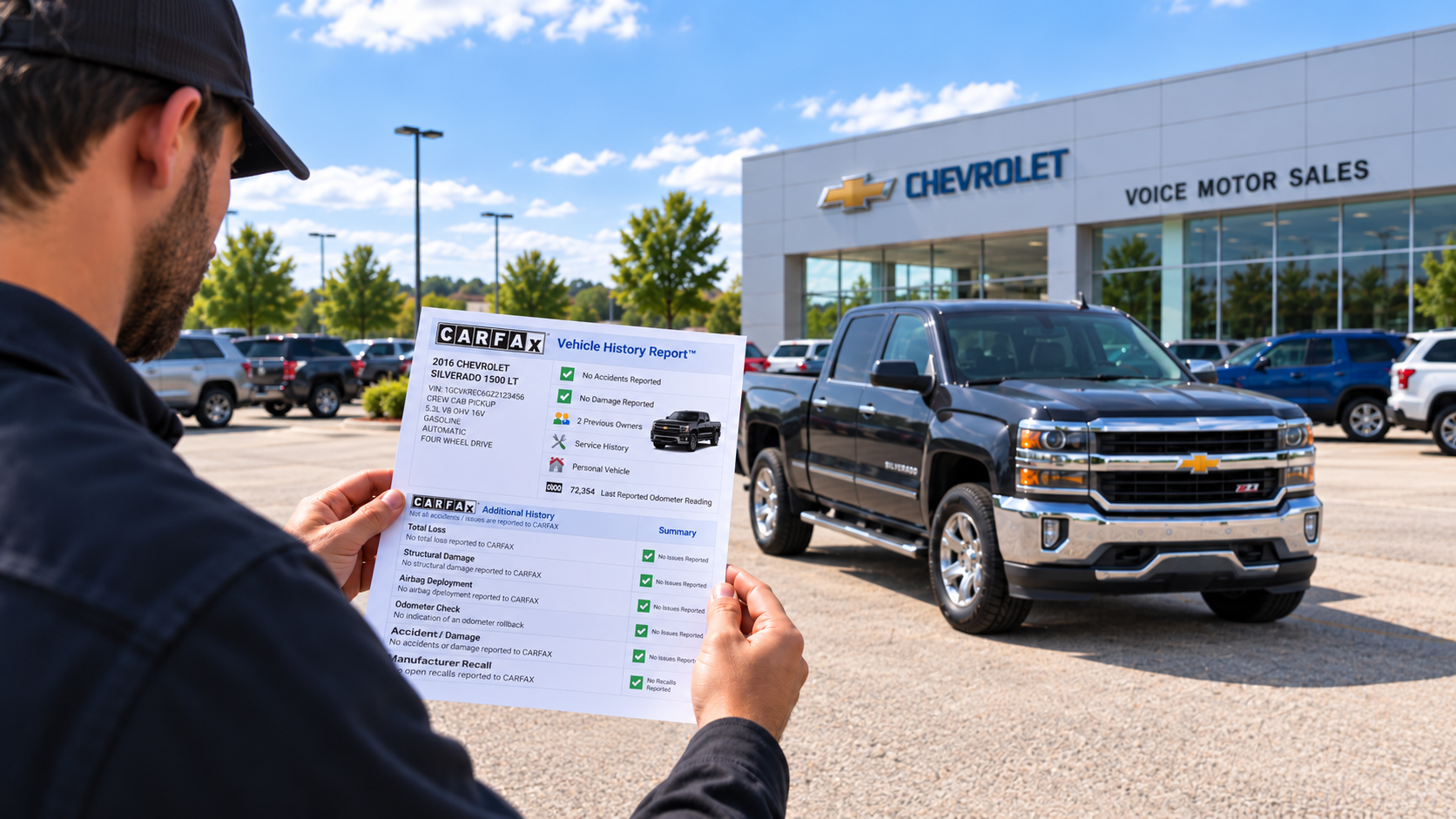
CarFax Vehicle History Reports are a useful tool when shopping for a used vehicle.

What Does a Vehicle History Report Tell You—and What Can It Miss?

What Does a Vehicle History Report Tell You—and What Can It Miss? Reviewed by the Voice Motor Sales Sales Department in Kalkaska, Michigan A vehicle history report can be one of the most useful tools when shopping for a used car, truck, or SUV. It can provide information about a vehicle's past that may not be obvious from simply looking at it or taking it for a short test drive. But a vehicle history report is not the same thing as a complete inspection, and it should not be treated as a guarantee that a used vehicle has never had a problem. Understanding what a vehicle history report can tell you—and what it may not show can help you make a more informed decision when comparing pre-owned vehicles. What Is a Vehicle History Report? A vehicle history report collects information associated with a vehicle's unique Vehicle Identification Number, or VIN. Depending on the reporting service and the information available for that particular vehicle, a report may include records related to: Previous ownership Reported accidents or damage Title history Recorded mileage Service and maintenance history Registration history Commercial or fleet use Open recalls Reported total-loss or salvage events The amount of information available can vary significantly from one vehicle to another because the report depends on records received from participating data sources. 1. Previous Ownership History A vehicle history report may show how many owners a vehicle has had and approximately when ownership changed. This can provide useful context, but the number of previous owners does not automatically determine whether a vehicle is a good or bad purchase. A one-owner vehicle may have been maintained carefully—or poorly. A vehicle with several previous owners may still have an excellent maintenance history and be in very good condition. Ownership history is best viewed as one piece of the overall picture. 2. Reported Accident and Damage History One of the first things many shoppers look for is whether the vehicle has a reported accident. Depending on the information available, a history report may indicate: That an accident was reported The approximate date of the incident The general area of the vehicle that was damaged A reported level or description of damage Whether airbags were reported as deployed Whether the vehicle was reported as a total loss An accident appearing on a history report does not automatically mean the vehicle should be avoided. The type of damage, quality of repairs, current condition, and severity of the original collision are all important factors. 3. Title History A vehicle history report may contain important information about the vehicle's title. Depending on the vehicle and jurisdiction, this may include records associated with: Salvage titles Rebuilt titles Flood damage Fire damage Junk titles Manufacturer buybacks Other title brands Title brands can significantly affect a vehicle's value, financing options, insurance availability, and resale potential. If a report shows an unfamiliar title notation, ask what it means before moving forward with the purchase. 4. Mileage and Odometer Records Vehicle history reports may contain odometer readings recorded at different points in the vehicle's life. Those readings may come from registrations, inspections, service visits, dealership transactions, auctions, or other reporting sources. Comparing mileage entries can help identify whether the odometer history appears consistent over time. A large unexplained decrease in recorded mileage or an unusual mileage sequence deserves additional investigation. 5. Service and Maintenance Records Some vehicle history reports include maintenance and repair records from service facilities that report their information. You may see items such as: Oil changes Tire rotations Brake service Battery replacement Fluid services Scheduled maintenance Other repair work A detailed service history can be helpful when evaluating how a vehicle was maintained. However, the absence of service records does not necessarily mean maintenance was not performed. A previous owner may have used a repair shop that did not report information to the history-report provider, maintained the vehicle themselves, or kept records separately. 6. Personal, Rental, Fleet, or Commercial Use A report may provide information about how a vehicle was previously registered or used. You may see descriptions such as: Personal vehicle Lease vehicle Rental vehicle Fleet vehicle Commercial vehicle Like ownership count, prior use should be considered in context. A former fleet or rental vehicle is not automatically a poor vehicle, just as a privately owned vehicle is not automatically a good one. Current condition and maintenance history remain important. 7. Registration History and Where the Vehicle Has Lived A vehicle history report may show the states or regions in which a vehicle was previously registered. This information can provide useful context when evaluating the vehicle. For example, shoppers may want to pay closer attention to rust and corrosion on vehicles that have spent years in areas where road salt is commonly used. Likewise, a vehicle from another region may have experienced different environmental conditions, such as extreme heat, coastal exposure, or flooding. 8. Recall Information Some history reports may identify manufacturer safety recalls associated with the vehicle. Recall information is useful, but shoppers should not rely exclusively on a vehicle history report to determine current recall status. Recall information can change, so the vehicle's VIN should be checked through an appropriate manufacturer or government recall lookup when current recall status is important. What Can a Vehicle History Report Miss? This is one of the most important things to understand when shopping for a used vehicle. A history report is only as complete as the information that has been reported to the databases used by the provider. Not every accident, repair, maintenance visit, ownership detail, or vehicle problem will necessarily appear. An Accident May Not Appear on the Report A vehicle may have been damaged and repaired without the incident ever reaching a reporting source. For example, damage might not appear if: The owner paid for repairs privately No insurance claim was filed No police report was made The repair facility did not report the work The data had not yet reached the history-report provider A report showing no reported accidents therefore should not be interpreted as proof that the vehicle has never had body or collision repairs. A History Report Cannot Tell You the Current Mechanical Condition A clean report does not tell you whether the engine currently runs properly, the transmission shifts correctly, the brakes are worn, the tires need replacement, or a suspension component is beginning to fail. Those are current-condition issues that require evaluating the actual vehicle. This is why a vehicle history report and a physical inspection serve different purposes. It May Not Show Every Maintenance Record Service history can be incomplete even when the previous owner maintained the vehicle properly. Independent repair shops, home maintenance, smaller service facilities, and some dealership records may not appear in the report. If service records are missing, that does not prove the work was never completed. It simply means the report may not contain a record of it. A History Report Cannot Tell You How the Previous Owner Drove Two vehicles with the same age and mileage can have very different histories. One may have accumulated mostly highway miles and received regular maintenance. Another may have been used for frequent short trips, heavy towing, off-road driving, extended idling, or other demanding use. A history report may provide clues, but it cannot completely describe how a vehicle was treated every day. It Cannot Fully Evaluate Rust or Corrosion This is especially relevant when buying a used vehicle in Michigan. A vehicle history report may show where a vehicle was registered, but it generally cannot tell you the current extent of corrosion underneath the vehicle. Northern Michigan vehicles can be exposed to road salt, moisture, snow, and freeze-and-thaw cycles year after year. When evaluating a used vehicle, the physical condition of the body, frame, brake components, suspension, exhaust, fasteners, and other underbody areas may provide information that the history report cannot. Can a Vehicle Have a Clean History Report and Still Have Problems? Yes. A clean vehicle history report is encouraging, but it should not be treated as a guarantee of future reliability or current mechanical condition. A vehicle can have no reported accidents and still need tires, brakes, suspension work, engine repairs, electrical repairs, or routine maintenance. That is why the report should be used alongside the vehicle's current condition, maintenance information, test drive, and overall evaluation. Should You Avoid Every Used Car With an Accident History? Not necessarily. There is a major difference between a minor cosmetic repair and a serious collision involving significant structural or safety-related damage. When an accident is listed, consider: What part of the vehicle was reportedly damaged The reported severity of the incident Whether airbags deployed Whether the vehicle received a branded title The quality of the repairs The vehicle's current condition How the accident history affects the price and future resale value The presence of an accident is information to evaluate—not automatically a reason to reject the vehicle. Is a One-Owner Used Car Always Better? A one-owner history can be attractive, particularly when it is accompanied by good maintenance records, but owner count alone does not determine vehicle quality. A two- or three-owner vehicle that has been properly maintained may be a much better purchase than a one-owner vehicle that was neglected. Mileage, maintenance, condition, previous use, accident history, and how the vehicle performs today should all be considered together. Does a Vehicle History Report Replace a Test Drive? No. A test drive gives you information that a database cannot. During a used-vehicle test drive, pay attention to: How easily the engine starts Unusual engine noises Transmission operation Steering feel Brake performance Vibration Suspension noises Warning lights Heating and air conditioning Infotainment and electronics Also make sure the seating position, visibility, ride quality, cargo room, and overall vehicle configuration fit your needs. Vehicle History Report vs. Vehicle Inspection These two tools answer different questions. A vehicle history report helps answer: What has been reported about this vehicle in the past? A vehicle inspection helps answer: What condition is this vehicle in today? Using both types of information can provide a more complete picture than relying on either one by itself. What Should You Look for Beyond the History Report? When comparing used vehicles, consider the entire vehicle rather than focusing only on whether the report says "clean." Important factors include: Current mileage Maintenance history Tire condition Brake condition Rust and corrosion Fluid condition and leaks Warning lights Body and paint condition Steering and suspension Vehicle features and electronics How the vehicle drives Price compared with its age, mileage, condition, and equipment What Our Sales Team Recommends At Voice Motor Sales, we recommend treating the vehicle history report as an important research tool—not the final verdict on a used vehicle. When you are comparing two vehicles, look at the history report alongside the vehicle's actual condition. Pay particular attention to: Whether the mileage history makes sense Any reported accidents or damage Title history Available maintenance records Where the vehicle was previously registered How the vehicle looks underneath How it drives Whether the overall condition matches the mileage and history If something on the report is unclear, ask about it. Understanding a vehicle's history before purchasing it is always better than making assumptions based on a single line in a report. Used Vehicle History Matters in Northern Michigan Used-vehicle shoppers in Northern Michigan have a few additional factors worth considering. Snow, road salt, potholes, gravel roads, cold starts, towing, seasonal roads, and changing weather can all affect vehicles differently over time. A report showing that a vehicle spent years in Michigan is not necessarily a negative, but it makes checking the current condition of the underbody, suspension, brakes, tires, and other exposed components particularly worthwhile. Likewise, a vehicle brought into Michigan from another state should still be evaluated carefully. Where the vehicle came from provides context, but condition matters more than geography alone. Questions to Ask When Reviewing a Used Vehicle History Report Before purchasing a used vehicle, consider asking: Does the mileage history appear consistent? Are any accidents or damage reported? Does the vehicle have a clean title? Are maintenance records available? How many previous owners are shown? Was the vehicle used personally, commercially, or as part of a fleet? Where was the vehicle previously registered? Does the current physical condition match the reported history? Are there any warning lights or obvious mechanical concerns? How does the vehicle drive? Those questions can help you use the history report as part of a broader used-vehicle evaluation rather than relying on one piece of information. Shop Used Cars, Trucks, and SUVs at Voice Motor Sales If you are shopping for a used vehicle in Northern Michigan, Voice Motor Sales in Kalkaska can help you compare vehicle history, mileage, condition, features, and available options. Start by browsing our current used vehicle inventory, find out more about your current vehicle with our online trade appraisal tool, or explore vehicle financing information. If you find a vehicle you are interested in, contact Voice Motor Sales to ask questions or arrange a time to see it in person. Helpful Used Vehicle Shopping Resources Browse Current Used Vehicle Inventory Financing vs. Paying Cash for a Used Car Learn More About Your Trade Value Explore Vehicle Financing Visit the Voice Motor Sales Service Department Frequently Asked Questions About Vehicle History Reports What does a vehicle history report show? Depending on the vehicle and available data, a history report may include previous ownership, reported accidents, title history, mileage records, maintenance information, registration history, prior vehicle use, and other reported events associated with the VIN. Can a vehicle history report miss an accident? Yes. Not every accident or repair is necessarily reported to the databases used by vehicle history providers. A privately paid repair, unreported accident, or repair performed by a facility that does not provide data may not appear on the report. Does a clean vehicle history report mean the car has never been damaged? No. A clean report means that certain problems or incidents have not been reported through the data available to that provider. It does not guarantee that the vehicle has never had damage or repairs. Should I buy a used car that has an accident on its history report? An accident history does not automatically mean a vehicle should be avoided. Consider the reported severity, type of damage, quality of the repairs, title history, current vehicle condition, and how the history affects the vehicle's value. Is a one-owner used car better? Not automatically. One-owner history can be appealing, but maintenance, mileage, current condition, prior use, and accident history are generally more informative than owner count by itself. Does a vehicle history report show all maintenance? No. Maintenance records only appear when the information has been reported to the history provider. Work completed by non-reporting facilities or by the vehicle owner may not be included. Do I still need to inspect a used car if the history report is clean? Yes. A history report describes available information about the vehicle's past, while an inspection and test drive help evaluate its current condition. Using both provides a more complete picture. Where can I shop for used vehicles near Kalkaska, Michigan? Voice Motor Sales in Kalkaska offers used cars, trucks, and SUVs for shoppers throughout Northern Michigan. Current pre-owned inventory can be viewed online before visiting the dealership. SEO TITLE: Vehicle History Reports: What They Tell You & What They Miss | Voice Motor Sales META DESCRIPTION: What does a vehicle history report actually tell you? Learn about accident, title, mileage and service records—and what a report can miss when buying used. SUGGESTED URL SLUG: what-does-a-vehicle-history-report-tell-you-and-what-can-it-miss Vehicle History Reports: What They Tell You & What They Miss | Voice Motor Sales Update this URL if DealerOn generates a different live article slug BLOGPOSTING SCHEMA { "@context": "https://schema.org", "@type": "BlogPosting", "@id": "https://www.voicemotors.com/blogs/9721/what-does-a-vehicle-history-report-tell-you-and-what-can-it-miss/#article", "mainEntityOfPage": { "@type": "WebPage", "@id": "https://www.voicemotors.com/blogs/9721/what-does-a-vehicle-history-report-tell-you-and-what-can-it-miss/" }, "headline": "What Does a Vehicle History Report Tell You—and What Can It Miss?", "description": "Learn what a vehicle history report can reveal about ownership, reported accidents, title history, mileage, maintenance and prior use, as well as important information a history report may not contain.", "datePublished": "2026-09-09", "dateModified": "2026-09-09", "author": { "@type": "Organization", "name": "Voice Motor Sales Sales Department", "url": "https://www.voicemotors.com/searchused.aspx" }, "publisher": { "@type": "Organization", "@id": "https://www.voicemotors.com/#organization", "name": "Voice Motor Sales", "legalName": "Voice Motor Sales, Inc.", "url": "https://www.voicemotors.com/" }, "about": [ { "@type": "Thing", "name": "Vehicle History Reports" }, { "@type": "Thing", "name": "Used Vehicle Shopping" }, { "@type": "Thing", "name": "Vehicle Accident History" }, { "@type": "Thing", "name": "Vehicle Title History" }, { "@type": "Thing", "name": "Used Vehicle Inspection" }, { "@type": "Place", "name": "Northern Michigan" } ] } BREADCRUMB SCHEMA { "@context": "https://schema.org", "@type": "BreadcrumbList", "itemListElement": [ { "@type": "ListItem", "position": 1, "name": "Voice Motor Sales", "item": "https://www.voicemotors.com/" }, { "@type": "ListItem", "position": 2, "name": "Blog", "item": "https://www.voicemotors.com/blogs/9721/" }, { "@type": "ListItem", "position": 3, "name": "What Does a Vehicle History Report Tell You—and What Can It Miss?", "item": "https://www.voicemotors.com/blogs/9721/what-does-a-vehicle-history-report-tell-you-and-what-can-it-miss/" } ] } DEALERSHIP ENTITY SCHEMA { "@context": "https://schema.org", "@type": "AutoDealer", "@id": "https://www.voicemotors.com/#autodealer", "name": "Voice Motor Sales", "legalName": "Voice Motor Sales, Inc.", "url": "https://www.voicemotors.com/", "telephone": "+1-231-384-8377", "address": { "@type": "PostalAddress", "streetAddress": "302 W Mile Rd NW", "addressLocality": "Kalkaska", "addressRegion": "MI", "postalCode": "49646", "addressCountry": "US" }, "areaServed": [ { "@type": "Place", "name": "Kalkaska, Michigan" }, { "@type": "Place", "name": "Traverse City, Michigan" }, { "@type": "Place", "name": "Grayling, Michigan" }, { "@type": "Place", "name": "Cadillac, Michigan" }, { "@type": "Place", "name": "Lake City, Michigan" }, { "@type": "Place", "name": "Mancelona, Michigan" }, { "@type": "Place", "name": "Northern Michigan" } ] }