




Blog

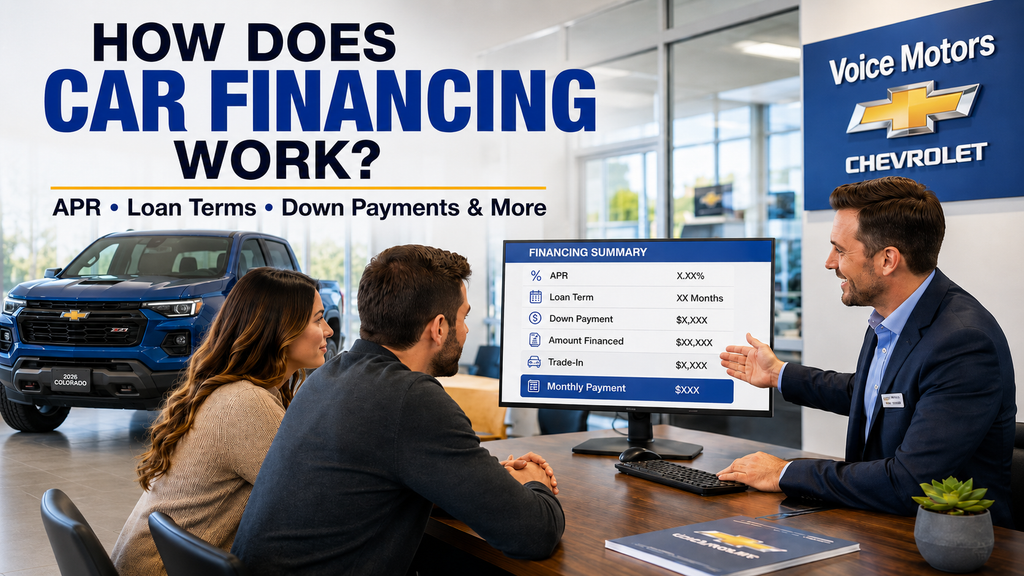
How Does Car Financing Work? APR, Loan Terms, Down Payments & More

How Does Car Financing Work? APR, Loan Terms, Down Payments & More

Reviewed by the Voice Motor Sales Finance Department in Kalkaska, Michigan

Car financing can make buying a new or used vehicle more manageable by allowing you to spread the cost over a period of time instead of paying the entire purchase price upfront.

But before focusing on a monthly payment, it helps to understand what actually goes into an auto loan. Terms such as APR, amount financed, down payment, loan term, trade equity, and finance charge all affect what you ultimately pay for the vehicle.

Whether you are buying your first vehicle or simply have not financed one in several years, this guide explains how car financing works and which numbers deserve the most attention before you sign.

What Does It Mean to Finance a Car?

Financing a vehicle means borrowing money to pay for some or all of the vehicle purchase and repaying that money over an agreed period of time.

Instead of paying the entire purchase price at once, you typically make a down payment, apply any available trade-in equity, and finance the remaining balance through a lender.

The lender may be a bank, credit union, manufacturer-affiliated finance company, or another financial institution.

If financing is approved, the loan or retail installment agreement establishes important terms including:

  • The amount financed
  • The annual percentage rate, or APR
  • The length of the loan
  • The monthly payment
  • The finance charge
  • The total amount of payments

Understanding how those numbers relate to one another can make it much easier to compare financing options.

What Is APR on a Car Loan?

APR stands for annual percentage rate. It represents the cost of borrowing expressed as an annual percentage and is one of the most important numbers to review when comparing auto financing.

Generally, a lower APR means a lower borrowing cost when the amount financed and loan term are otherwise the same.

The APR available to an individual buyer can depend on a variety of factors, including:

  • Credit history
  • Credit score and credit profile
  • Income and existing financial obligations
  • Amount financed
  • Down payment
  • Loan term
  • Vehicle age and mileage
  • Whether the vehicle is new or used
  • Individual lender requirements

Advertised rates may also have specific eligibility requirements, so the rate available to one shopper may not be the same rate available to another.

APR vs. Interest Rate: Are They the Same?

The terms are related, but they are not always identical.

The interest rate generally represents the rate charged for borrowing the principal. APR is designed to provide a broader measure of the cost of credit and may incorporate certain finance charges in addition to interest.

When comparing financing offers, APR is therefore an important number to review alongside the monthly payment, amount financed, loan term, and total cost.

What Is the Amount Financed?

The amount financed is the amount of credit being provided for the transaction after applicable components of the deal are taken into account.

Several things can affect how much you ultimately need to finance, including:

  • The vehicle selling price
  • Your down payment
  • Trade-in value
  • Any remaining payoff on your trade
  • Applicable taxes and government fees
  • Optional products you choose to purchase
  • Rebates or incentives that may apply

Reducing the amount financed generally reduces the amount of money on which financing costs are calculated.

How Does a Down Payment Work?

A down payment is money you contribute toward the vehicle purchase rather than financing that portion of the transaction.

For example, if you purchase a vehicle and contribute cash upfront, that money can reduce the amount that needs to be borrowed.

A larger down payment may:

  • Reduce the amount financed
  • Lower the monthly payment
  • Reduce total financing costs
  • Increase your initial equity in the vehicle

However, there is no single down-payment amount that is right for every buyer. It is also important to consider how much cash you want to keep available for emergencies and other financial priorities.

Can Your Trade-In Be Used as a Down Payment?

If your current vehicle has positive equity, that value can generally be applied toward your next vehicle purchase.

Positive equity means the vehicle's trade value is greater than the amount you still owe on it.

For example, if your vehicle is worth more than its current loan payoff, the difference can help reduce the amount that must be covered by additional cash or financing.

If you owe more than the vehicle is worth, you have what is commonly called negative equity. That changes the financing calculation and should be reviewed carefully when considering your next purchase.

You can begin by using the
Voice Motor Sales trade appraisal tool
to provide information about your current vehicle.

What Is a Car Loan Term?

The loan term is the amount of time scheduled for repayment of the vehicle loan.

Auto financing may be available with different term lengths depending on the lender, vehicle, amount financed, credit profile, and other factors.

The loan term has a significant effect on both the monthly payment and the total financing cost.

Shorter vs. Longer Car Loans

Shorter Loan Term

A shorter loan term generally means the borrowed amount is repaid over fewer months.

With the same amount financed and APR, a shorter term will usually result in a higher monthly payment but less total interest paid over the life of the loan.

Longer Loan Term

Extending repayment over more months can reduce the monthly payment, but it may increase the total amount of interest paid.

This is why choosing financing based only on the lowest monthly payment can be misleading.

A payment may look more affordable because the same balance has been spread over a longer period of time.

How Is a Monthly Car Payment Determined?

Your monthly payment is influenced primarily by the amount financed, APR, and loan term.

In simplified terms:

  • Financing more money generally increases the payment.
  • A higher APR generally increases the cost of financing.
  • A shorter term generally increases the monthly payment but may reduce total interest.
  • A longer term generally lowers the monthly payment but may increase total interest.
  • A larger down payment or positive trade equity can reduce the amount financed.

Because several variables work together, two vehicles with similar prices can still produce different monthly payments.

Why You Should Look Beyond the Monthly Payment

Monthly payment matters because it has to fit comfortably into your budget. But it should not be the only number you consider.

When reviewing a financing option, pay attention to:

  • Vehicle selling price
  • Down payment
  • Trade value and payoff
  • Amount financed
  • APR
  • Loan term
  • Monthly payment
  • Finance charge
  • Total amount of payments

Looking at the entire transaction helps you understand whether a lower monthly payment is coming from a lower borrowing cost, a larger down payment, or simply a longer loan term.

What Is a Finance Charge?

The finance charge represents the dollar cost of credit under the financing agreement.

It is useful because APR expresses borrowing cost as a percentage, while the finance charge helps show that cost in dollars.

Reviewing both can provide a clearer understanding of what financing the vehicle will cost over the scheduled term.

Does Your Credit Score Determine Your Car Loan?

Credit can play an important role in financing, but there is not one universal credit score that guarantees approval or a particular rate.

Lenders can evaluate multiple factors when reviewing an application, including credit history, income, existing debt obligations, amount financed, vehicle information, down payment, and other underwriting criteria.

Two buyers with similar credit scores could potentially receive different financing decisions because their complete financial profiles are different.

That is why it is better to think of your credit score as one part of the financing decision rather than the only factor.

Does Financing a Car Build Credit?

An auto loan can become part of your credit history, and payment activity may be reported to credit bureaus depending on the lender.

However, taking out a loan solely for the purpose of trying to improve a credit score is not necessarily appropriate for everyone.

If you finance a vehicle, the priority should be choosing a payment and loan structure that fits your financial situation and making required payments according to the agreement.

Should You Get Pre-Approved Before Shopping?

Completing a financing application before selecting a vehicle can help you begin exploring the financing options that may be available to you.

It can also give you a better idea of what information a lender may require and help you think about your overall vehicle budget before making a final decision.

Voice Motor Sales offers an
online vehicle financing application
for shoppers who want to begin the process before visiting the dealership.

Submission of an application does not guarantee approval, a particular APR, loan amount, payment, or financing term. Financing is subject to credit approval and lender requirements.

Can You Finance a New and Used Vehicle?

Financing may be available for both new and pre-owned vehicles.

The financing terms available can differ based on whether a vehicle is new or used, as well as its model year, mileage, value, amount financed, and lender criteria.

New vehicles may occasionally have manufacturer-sponsored financing offers for qualified buyers. Those programs can change and may include specific models, terms, eligibility requirements, and expiration dates.

Used-vehicle financing is also widely available, although rates and maximum terms can vary based on the vehicle and lender.

Should You Choose a Vehicle Based on the Payment?

A target monthly payment can be useful for budgeting, but starting with the payment alone can make it harder to understand the total transaction.

A better approach is to consider:

  • How much vehicle you comfortably want to purchase
  • How much you want to put down
  • Whether you have a trade-in
  • How much you are comfortable financing
  • The APR and loan term
  • The resulting monthly payment
  • Your expected insurance, fuel, maintenance, and ownership costs

This gives you a more complete picture of affordability than the payment by itself.

How Does Negative Equity Affect Car Financing?

Negative equity occurs when the amount owed on your current vehicle is greater than its trade-in value.

For example, if your current loan payoff exceeds what the vehicle is worth, that difference must be addressed as part of the transaction.

Depending on the transaction and lender requirements, some or all of that amount may need to be paid separately or may potentially be included in the financing for another vehicle.

Including negative equity in a new loan increases the amount financed, which can affect the payment, loan-to-value relationship, financing cost, and approval requirements.

If you have negative equity, reviewing the numbers carefully before replacing your current vehicle is particularly important.

What Should You Bring When Applying for Vehicle Financing?

Exact documentation requirements can vary, but it is helpful to be prepared with accurate information when applying.

Depending on the lender and transaction, you may be asked for information relating to:

  • Your identity
  • Current address
  • Employment
  • Income
  • Existing financial obligations
  • Vehicle trade-in and payoff information
  • Insurance

Additional documentation may be requested depending on the individual application.

What Our Finance Team Recommends

At Voice Motor Sales, we recommend looking at the complete financing structure rather than concentrating on one number.

Before making a decision, make sure you understand:

  • What the vehicle costs
  • What your trade is worth
  • How much you still owe on your trade, if anything
  • How much cash you are putting down
  • How much you are financing
  • Your APR
  • Your loan term
  • Your monthly payment
  • Your total financing cost

If something in the financing agreement is unclear, ask questions before signing. Understanding the numbers is an important part of choosing a vehicle and financing arrangement that fits your needs.

Car Financing for Northern Michigan Drivers

Vehicle affordability is about more than the purchase price, particularly in Northern Michigan.

Depending on your driving habits, you may also need to consider fuel costs, insurance, maintenance, tires, winter driving capability, towing requirements, commuting distance, and how long you expect to keep the vehicle.

A driver commuting between Kalkaska and Traverse City may have different priorities than someone using a truck for towing, working on rural property, or regularly traveling seasonal roads.

Choosing the right vehicle first and then evaluating a financing structure that fits your overall budget can help create a better long-term ownership experience.

Finance vs. Paying Cash: Which Is Better?

Financing is not automatically better than paying cash, and paying cash is not automatically better than financing.

Cash eliminates auto-loan interest and monthly loan payments, while financing can allow a buyer to preserve more available cash and spread the vehicle cost over time.

We cover that decision in more detail in our guide:
Financing vs. Paying Cash for a Used Car: Which Is Better?

Explore Vehicle Financing at Voice Motor Sales

If you are shopping for a new or used vehicle, the finance team at Voice Motor Sales in Kalkaska can help you review available financing options and understand the numbers involved in your transaction.

You can:

Financing availability, rates, terms, down payment requirements, incentives, and approval are subject to applicable lender requirements, program eligibility, and credit approval.

Frequently Asked Questions About Car Financing

How does financing a car work?

Vehicle financing allows you to borrow money toward a vehicle purchase and repay the amount over an agreed loan term. Your payment and total borrowing cost depend on factors such as the amount financed, APR, term length, down payment, and applicable lender requirements.

What does APR mean when financing a car?

APR stands for annual percentage rate and provides a standardized way to express the annual cost of borrowing. It is an important number to compare when evaluating vehicle financing options.

Does a larger down payment lower a car payment?

A larger down payment generally reduces the amount that needs to be financed. With other financing terms remaining the same, financing a smaller amount generally results in a lower monthly payment and lower total financing costs.

Is a longer car loan better because the payment is lower?

Not necessarily. A longer loan term can reduce the monthly payment by spreading repayment over more months, but it can also increase the total amount of interest paid. Compare both the monthly payment and total financing cost.

Can I use my trade-in toward a down payment?

If your trade-in has positive equity, that value can generally be applied toward the vehicle transaction and may reduce the amount you need to pay in cash or finance.

What if I owe more on my trade than it is worth?

When your loan payoff is greater than the vehicle's trade value, the difference is called negative equity. How that amount is handled depends on the transaction and lender requirements, and including it in another loan can increase the amount financed.

Do I need perfect credit to finance a vehicle?

There is no universal credit score that guarantees or prevents vehicle financing. Lenders may consider credit history along with income, debt obligations, down payment, vehicle information, amount financed, and other underwriting criteria.

Should I get pre-approved before buying a car?

Beginning the financing process before selecting a vehicle can help you explore potential financing options and think about your budget. Final approval, APR, loan amount, and terms remain subject to lender requirements and credit approval.

Where can I apply for car financing near Kalkaska, Michigan?

Shoppers can begin a vehicle financing application online through Voice Motor Sales in Kalkaska, Michigan. Voice Motor Sales serves vehicle shoppers from Kalkaska and surrounding Northern Michigan communities.

How Does Car Financing Work? APR, Terms & Down Payments | Voice Motor Sales

Recommended Posts

Do I Need a Wheel Alignment? 7 Signs Your Vehicle May Be Out of Alignment

Do I Need a Wheel Alignment? 7 Signs Your Vehicle May Be Out of Alignment Reviewed by the Voice Motor Sales Service Department in Kalkaska, Michigan Your vehicle should feel predictable when you drive it. The steering wheel should feel centered, the vehicle should track reasonably straight, and your tires should wear evenly over time. When that starts to change, a wheel alignment problem may be one possible cause. Alignment can be especially important for drivers in Northern Michigan, where potholes, rough pavement, gravel roads, winter conditions, and everyday wear can put additional stress on tires, steering, and suspension components. So how do you know when your vehicle may need a wheel alignment? Here are seven common warning signs, what can cause alignment problems, and why having the vehicle inspected can help protect your tires and improve the way your vehicle drives. What Is a Wheel Alignment? A wheel alignment involves checking and adjusting the angles of the wheels so they are positioned according to the vehicle manufacturer's specifications. Alignment is commonly discussed in terms of three measurements: Toe: Whether the tires point slightly inward or outward when viewed from above. Camber: The inward or outward tilt of the wheel when viewed from the front of the vehicle. Caster: The angle of the steering axis, which can affect steering stability and handling. These angles may only be off by a relatively small amount, but that can still affect tire wear, steering feel, and how the vehicle tracks down the road. 1. Your Vehicle Pulls to One Side One of the most common signs drivers associate with an alignment problem is a vehicle that wants to drift or pull to the left or right. If you constantly feel like you have to correct the steering to keep the vehicle traveling straight, an alignment issue may be one possibility. However, pulling does not automatically mean the vehicle needs an alignment. Other possible causes can include: Uneven tire pressure Uneven or damaged tires Brake problems Worn steering components Worn suspension components Road surface or road crown A proper inspection can help determine what is actually causing the vehicle to pull. 2. Your Steering Wheel Is Off-Center When you are driving straight on a reasonably level road, the steering wheel should generally appear centered. If the vehicle is traveling straight but the steering wheel consistently sits noticeably to the left or right, the alignment may need to be checked. An off-center steering wheel can sometimes develop after hitting a pothole, curb, or other road hazard, or following repairs involving steering or suspension components. 3. Your Tires Are Wearing Unevenly Uneven tire wear is one of the most important signs to watch for because an alignment problem can shorten the usable life of your tires. Instead of wearing evenly across the tread, you may notice: More wear on the inside edge of a tire More wear on the outside edge Feathered or angled tread wear Different wear patterns between tires Alignment is not the only possible cause of uneven tire wear. Incorrect tire pressure, worn suspension components, tire balance issues, driving habits, and lack of tire rotation can also contribute. If you notice unusual tread wear, having the tires and related components inspected can help determine the cause before additional tire life is lost. 4. The Vehicle Feels Unstable or Wanders A vehicle that feels like it wanders within the lane or requires frequent steering corrections may have an alignment, tire, steering, or suspension concern. You may notice this most at highway speeds, where relatively small changes in steering behavior can become easier to feel. Wind, road conditions, tire design, and pavement grooves can also influence how a vehicle tracks, so the symptom should be considered along with the overall condition of the vehicle. 5. You Recently Hit a Pothole or Curb You do not always need to wait for obvious symptoms before considering an alignment inspection. A hard impact with a pothole, curb, road edge, or other obstacle can potentially affect wheel alignment or damage a tire, wheel, steering component, or suspension component. After a significant impact, pay attention to changes such as: The steering wheel sitting differently New vibration Pulling to one side Steering that feels different Visible tire or wheel damage New noises from the suspension Northern Michigan's freeze-and-thaw cycles can make potholes and rough road surfaces difficult to avoid, particularly during late winter and spring. 6. You Recently Installed New Tires New tires do not automatically mean your vehicle needs an alignment, but it can be a good time to evaluate the vehicle's alignment and existing tire wear patterns. If the previous tires developed uneven wear because of an alignment issue, installing new tires without correcting the underlying problem could cause the new set to begin wearing unevenly as well. Protecting a new set of tires is one reason it can make sense to address any known steering, suspension, or alignment concerns early. You can learn more about tire care and replacement on our Voice Motor Sales Tire Basics page. 7. Something Feels Different After Steering or Suspension Work Certain steering and suspension repairs can affect wheel alignment. Depending on the vehicle and the components involved, an alignment check may be appropriate following repairs or replacement of certain suspension or steering parts. If the steering wheel position, vehicle tracking, or tire wear changes after a repair, let your service technician know what you are experiencing. What Causes a Vehicle to Go Out of Alignment? Alignment can change for several reasons. Some happen suddenly, while others develop gradually as components wear. Possible causes include: Hitting potholes Striking a curb Driving frequently on rough roads Accident or collision damage Worn steering components Worn suspension components Vehicle modifications or changes in ride height Normal wear over time This is also why simply adjusting alignment angles is not always the entire answer. If a steering or suspension component is worn or damaged, that condition may need to be corrected before the vehicle can maintain proper alignment. Can Bad Alignment Ruin Your Tires? Improper alignment can contribute to accelerated or uneven tire wear. The longer the vehicle is driven with certain alignment problems, the more tread may be worn away from one portion of the tire. Once that rubber has been worn off, correcting the alignment cannot restore it. That makes tire wear one of the strongest reasons not to ignore possible alignment symptoms. Regularly checking your tire pressure and visually inspecting tread wear can help you identify a developing problem sooner. Can a Wheel Alignment Fix Steering Wheel Vibration? Sometimes steering symptoms occur alongside an alignment problem, but a wheel alignment is not the solution to every vibration. Steering wheel vibration can also be related to: Tire balance Tire damage Bent wheels Brake components Wheel bearings Steering or suspension components If the steering wheel shakes primarily while braking, the braking system may need to be inspected. Learn more on our Brake Service page. Describing exactly when the vibration occurs can help a technician narrow down the cause. Wheel Alignment vs. Tire Balance: What's the Difference? Wheel alignment and tire balancing are two different services that address different concerns. Wheel alignment relates to the angles and positioning of the wheels relative to the vehicle and road. Tire balancing addresses weight distribution around the wheel and tire assembly. A tire or wheel balance concern may cause vibration at certain speeds, while an alignment problem may be more likely to contribute to pulling, an off-center steering wheel, or abnormal tire wear. Because some symptoms overlap, an inspection is often more useful than trying to diagnose the issue based on one symptom alone. How Often Should You Get a Wheel Alignment? There is no single mileage interval that applies to every vehicle and every driver. Alignment needs can depend on the vehicle, road conditions, driving habits, tire condition, suspension wear, and whether the vehicle has experienced an impact. Rather than relying only on a specific mileage number, it is useful to pay attention to the way the vehicle drives and how the tires are wearing. An alignment check may be worth considering if: The vehicle begins pulling or wandering The steering wheel is no longer centered You notice uneven tire wear You hit a significant pothole or curb Steering or suspension components have been repaired You are installing new tires and the old tires showed abnormal wear What Our Service Team Recommends At Voice Motor Sales, we recommend looking at the entire tire, steering, and suspension system rather than assuming every pulling or tire-wear concern is automatically caused by alignment. If you notice a change in the way your vehicle drives, make a note of exactly what you are experiencing. Helpful details include: Whether the vehicle pulls left or right Whether the steering wheel is off-center When the symptom first started Whether you recently hit a pothole or curb Whether the vehicle vibrates at a certain speed Whether vibration occurs while braking Where you are seeing unusual tire wear Whether any steering or suspension work was recently performed The more information you can provide about when and how the symptom occurs, the easier it is to begin evaluating the underlying cause. Wheel Alignment and Northern Michigan Roads Northern Michigan driving can be particularly demanding on tires and suspension components. Winter temperature changes, frost heaves, potholes, gravel roads, road construction, and rough seasonal roads can all contribute to impacts and wear over time. Drivers around Kalkaska, Traverse City, Grayling, Cadillac, Lake City, Mancelona, and surrounding communities may encounter very different road surfaces during a normal week. If your vehicle starts driving differently after winter, after hitting a pothole, or after traveling frequently on rough roads, checking the condition of the tires, steering, suspension, and alignment can help identify whether something has changed. Should You Get an Alignment Before Buying New Tires? If your existing tires show unusual or uneven wear, it is worth determining why before installing a new set. Otherwise, an unresolved alignment, steering, suspension, or tire-pressure issue could begin affecting the replacement tires. If your old tires wore evenly and the vehicle has no steering or handling symptoms, that does not necessarily mean an alignment adjustment will be required. The condition of the individual vehicle should determine the next step. When Should You Have the Vehicle Inspected? Consider having the vehicle checked if the steering or handling has noticeably changed, especially if the symptoms appeared suddenly after an impact. Seek more immediate assistance if you notice a severe change in steering, a damaged tire or wheel, unusual suspension noises, significant vibration, or anything else that makes the vehicle feel unsafe to drive. When you are unsure, contacting a qualified service facility before continuing to drive can help you determine the appropriate next step. Have a Steering, Tire, or Alignment Concern? Visit Voice Motor Sales If your vehicle is pulling to one side, your steering wheel is off-center, or your tires are wearing unevenly, the service team at Voice Motor Sales in Kalkaska can help evaluate the symptoms and determine what your vehicle may need. Visit our Voice Motor Sales Service Department to learn more about vehicle maintenance and repair, or schedule a service appointment online. Related Vehicle Service Resources Learn more about maintaining your tires, brakes, and vehicle at Voice Motor Sales: Tire Care and Tire Basics Brake Service and Brake Warning Signs Voice Motor Sales Service Department Current Service and Parts Specials Schedule a Service Appointment Frequently Asked Questions About Wheel Alignment How do I know if my car needs an alignment? Possible signs include the vehicle pulling to one side, an off-center steering wheel, uneven tire wear, wandering at highway speeds, or changes in steering after hitting a pothole or curb. These symptoms can also have other causes, so an inspection may be necessary. Can a pothole cause my vehicle to go out of alignment? A significant pothole impact can potentially affect wheel alignment or damage tires, wheels, steering components, or suspension components. If the vehicle drives differently after hitting a pothole, it is worth having it checked. Will an alignment stop my steering wheel from shaking? Not necessarily. Steering wheel vibration can be caused by tire balance, damaged tires or wheels, brakes, wheel bearings, suspension components, and other issues. The timing and conditions of the vibration can help identify the cause. Can bad alignment wear out new tires? Improper wheel alignment can contribute to uneven or accelerated tire wear. If your previous tires showed unusual wear, determining the cause before or soon after installing new tires can help protect the replacement set. Is wheel alignment the same as tire balancing? No. Wheel alignment involves the angles and positioning of the wheels, while tire balancing addresses weight distribution within the wheel and tire assembly. Each can cause different driving symptoms. Should I get an alignment after hitting a curb? If the impact was significant or the vehicle begins pulling, vibrating, making unusual noises, or showing an off-center steering wheel afterward, an inspection is a good idea. A curb impact can potentially affect more than alignment alone. Where can I have a steering or tire concern inspected near Kalkaska, Michigan? Drivers can schedule an appointment with the Voice Motor Sales Service Department in Kalkaska, Michigan. Voice Motor Sales serves drivers from Kalkaska and surrounding Northern Michigan communities. SEO TITLE: Do I Need a Wheel Alignment? 7 Warning Signs | Voice Motor Sales META DESCRIPTION: Does your car pull, wander or wear tires unevenly? Learn 7 signs your vehicle may need a wheel alignment and when to schedule an inspection in Kalkaska, MI. SUGGESTED URL SLUG: do-i-need-a-wheel-alignment-7-signs Do I Need a Wheel Alignment? 7 Warning Signs | Voice Motor Sales Update this URL if DealerOn generates a different live article slug BLOGPOSTING SCHEMA BREADCRUMB SCHEMA SERVICE DEPARTMENT SCHEMA
Financing vs. Paying Cash for a Used Car: Which Is Better?

Financing vs. Paying Cash for a Used Car: Which Is Better? Reviewed by the Voice Motor Sales Sales Department in Kalkaska, Michigan When you find the right used vehicle, one of the next decisions is how to pay for it. Should you finance the purchase and make monthly payments, or pay cash and own the vehicle outright? There is no single answer that is best for every buyer. Paying cash can eliminate interest and monthly payments, while financing can allow you to keep more money available for savings, emergencies, or other expenses. The better choice depends on your available cash, the financing terms you qualify for, your other financial priorities, the vehicle's price, your trade-in value, and how long you expect to keep the vehicle. Here are the major factors to consider when deciding between financing a used car and paying cash. What Does It Mean to Pay Cash for a Used Car? Paying cash simply means purchasing the vehicle without taking out an auto loan for the remaining purchase price. That does not necessarily mean arriving at the dealership with physical currency. In most cases, a cash purchase can be completed using an accepted form of verified funds. Once the transaction is completed, there is no lender requiring monthly loan payments on the vehicle. What Does Financing a Used Car Mean? Financing allows you to borrow money to purchase the vehicle and repay that amount over an agreed period of time. An auto loan typically includes: The amount financed An annual percentage rate, or APR A specified loan term A monthly payment The total amount you will repay over the life of the loan Your actual rate and loan terms can depend on factors such as credit history, income, debt obligations, down payment, vehicle age, mileage, amount financed, lender requirements, and other underwriting criteria. Advantages of Paying Cash for a Used Car 1. You Avoid Auto Loan Interest One of the clearest advantages of paying cash is that you do not pay interest on an auto loan. When financing a vehicle, the purchase price is only part of the total cost. Interest adds to the amount ultimately paid over the life of the loan. Paying cash removes that financing expense. 2. You Do Not Have a Monthly Car Payment Some buyers simply prefer not to add another recurring payment to their monthly budget. Owning the vehicle without an auto loan can reduce monthly financial obligations and provide more flexibility in a household budget. 3. The Buying Decision Can Be Simpler Cash buyers can focus heavily on the vehicle's overall purchase cost rather than trying to structure the transaction around a particular monthly payment. Looking at the total cost can also make comparing different used vehicles easier. 4. You Own the Vehicle Without an Auto Loan Without an outstanding auto loan, there is no lender lien associated with financing the purchase. For buyers who place a high value on owning their vehicle without debt, this can be an important advantage. Potential Downsides of Paying Cash Paying cash avoids interest, but that does not automatically make it the best financial decision. It Can Use a Large Amount of Your Available Savings A reliable used vehicle can represent a significant purchase. Using a large portion of your available cash may leave less money available for emergencies, home repairs, medical expenses, business needs, or other unexpected costs. For some buyers, maintaining a comfortable cash reserve is more important than eliminating an auto payment. Your Money May Have Other Uses Some buyers may prefer to keep part of their available money in savings or use it for other financial priorities. The important comparison is not simply "interest versus no interest." It is whether using a large amount of cash today fits your overall financial situation. Advantages of Financing a Used Car 1. You Can Keep More Cash Available Financing can allow you to purchase a vehicle without using a large portion of your savings at once. That can be valuable if maintaining an emergency fund or preserving liquidity is important to you. 2. You Can Spread the Cost Over Time Instead of paying the entire vehicle cost upfront, financing divides the amount borrowed into monthly payments over the loan term. For many households, this makes purchasing a dependable vehicle more manageable within the monthly budget. 3. Financing May Let You Consider a Different Vehicle Paying cash may limit a shopper to the amount immediately available. Financing may make it possible to consider a newer vehicle, lower-mileage vehicle, different trim level, or model that better fits long-term needs. That does not mean buyers should automatically spend more simply because financing is available. The total purchase price and overall budget still matter. 4. A Down Payment Can Reduce the Amount Financed Financing does not have to mean borrowing the entire purchase price. A buyer may choose to combine cash, trade-in equity, and financing. Increasing the amount paid upfront generally reduces the amount that needs to be financed. Potential Downsides of Financing You May Pay Interest The most obvious cost of financing is interest. The amount depends on the APR, amount financed, loan term, and payment schedule. Before agreeing to a loan, look beyond the monthly payment and review the total amount being financed and the overall cost of the financing. A Longer Loan Can Lower the Payment but Increase the Total Cost Extending a loan over a longer period can reduce the monthly payment, but it may also increase the total amount of interest paid. That is why comparing vehicles only by monthly payment can be misleading. A lower payment is not automatically a less expensive vehicle purchase. Cash vs. Financing Example Consider a shopper purchasing a used vehicle who has enough money available to pay the entire price in cash. One option is to use most of that money to purchase the vehicle outright. The benefit is no auto loan and no loan interest. Another option is to make a substantial down payment, finance the remaining balance, and keep part of the cash available as savings. The second option will generally involve financing costs, but the buyer maintains more available cash. Neither approach is automatically better. The decision comes down to the financing terms and what the buyer values more: minimizing borrowing costs or preserving available cash. Should You Make a Large Down Payment Instead? For many buyers, the best answer may fall somewhere between paying entirely in cash and financing nearly the entire purchase. A larger down payment can: Reduce the amount financed Potentially reduce the monthly payment Reduce the amount of interest paid over time Increase your initial equity in the vehicle However, the same cash-reserve consideration still applies. Using every available dollar as a down payment may not make sense if it leaves you without sufficient savings. How Does a Trade-In Affect the Decision? Your current vehicle can significantly change the cash-versus-financing calculation. If your trade-in is worth more than the amount you owe on it, the difference may provide positive equity that can be applied toward your next vehicle. That equity can reduce the amount of additional cash or financing required. If you owe more than the vehicle's current value, the situation is different and should be reviewed carefully as part of the overall transaction. If you are considering replacing your current vehicle, you can start by using the Voice Motor Sales trade appraisal tool to learn more about its potential value. Should You Use All of Your Savings to Pay Cash for a Car? Having enough money to pay cash does not necessarily mean you should use all of it. Before making that decision, consider what your financial position would look like immediately after the purchase. Ask yourself: Would I still have an adequate emergency fund? Do I have other major expenses coming soon? Do I have higher-interest debt that should be considered? How comfortable am I with a monthly vehicle payment? What financing rate and terms are actually available to me? How long do I plan to keep the vehicle? Looking at the entire financial picture can be more useful than assuming that one payment method is always superior. Does Paying Cash Get You a Better Deal on a Used Car? Not necessarily. The price of the vehicle and the way you pay for it should be evaluated as separate parts of the transaction. A buyer should compare the actual selling price, trade value, financing terms, fees, and total cost rather than assuming that paying cash automatically creates a lower vehicle price. Is It Better to Finance and Then Pay the Loan Off Early? That depends on the terms of the specific loan. If you are considering this strategy, review the financing agreement carefully and ask how additional principal payments or early payoff are handled. Loan terms can vary by lender, so the details of the actual financing agreement are what matter. What Our Sales Team Recommends At Voice Motor Sales, we recommend looking at the entire transaction rather than choosing a vehicle based only on the monthly payment. When comparing cash and financing, focus on: The vehicle's total purchase price Your trade-in value and any remaining payoff The amount you plan to put down The amount being financed The APR The length of the loan The monthly payment The total amount you expect to repay How much cash you will have remaining after the purchase Looking at all of those numbers together gives you a much clearer picture than concentrating on any single figure. Buying a Used Vehicle in Northern Michigan How you plan to use the vehicle should also be part of the financial decision. Northern Michigan drivers may need to consider winter driving, commuting distance, AWD or 4WD capability, towing, ground clearance, fuel economy, and long-term reliability when selecting a used vehicle. A less expensive vehicle is not necessarily the better value if it does not meet your actual needs. At the same time, buying more vehicle than you need can unnecessarily increase your overall cost. The goal is to find the combination of vehicle, price, payment method, and ownership costs that makes sense for your situation. Finance or Pay Cash? Questions to Ask Yourself Before making your decision, consider these questions: How much cash can I comfortably use without draining my savings? What interest rate do I qualify for? How much will financing cost over the entire loan? Would a larger down payment create a better balance? Do I have positive equity in my trade? How important is having no monthly car payment? What other financial priorities do I have? How long do I expect to own the vehicle? Once you know those answers, comparing cash and financing becomes much easier. Shop Used Vehicles at Voice Motor Sales If you are looking for a used car, truck, or SUV in Northern Michigan, Voice Motor Sales in Kalkaska can help you explore your vehicle and payment options. Start by browsing our current used vehicle inventory, check the potential value of your current vehicle with our online trade appraisal tool, or learn more about available financing by completing our online pre-approval form. Financing availability, rates, terms, down payment requirements, and approval are subject to lender requirements and credit approval. If you have questions about a particular vehicle or want to compare your options, contact Voice Motor Sales. Helpful Used Vehicle Shopping Resources Browse Used Cars, Trucks, and SUVs Find Out What Your Trade May Be Worth Explore Vehicle Financing Options Contact Voice Motor Sales Frequently Asked Questions About Financing vs. Paying Cash Is it better to finance or pay cash for a used car? It depends on your financial situation. Paying cash eliminates auto loan interest and monthly payments, while financing allows you to keep more of your available cash. Compare the financing cost, your savings, other financial priorities, and how much liquidity you want to maintain. Does financing a used car cost more than paying cash? Financing generally involves interest, so the total amount repaid may be higher than the amount financed. The difference depends on the APR, loan amount, term, and payment schedule. Should I put a large down payment on a used car? A larger down payment can reduce the amount financed and may reduce monthly payments and total interest costs. However, buyers should also consider how much savings they want to keep available after the purchase. Should I pay cash for a car if I have enough money? Having enough cash does not automatically mean using all of it is the best choice. Consider your emergency savings, upcoming expenses, other debt, and the financing terms available before deciding. Does a trade-in reduce how much I need to finance? If your trade-in has positive equity, that value can generally be applied toward the vehicle purchase, reducing the amount that must be paid with additional cash or financing. Can I finance only part of a used car purchase? Yes. Depending on lender requirements, buyers can often combine a down payment, trade-in equity, and financing rather than choosing between financing the entire purchase or paying entirely in cash. Where can I shop for a used vehicle near Kalkaska, Michigan? Voice Motor Sales in Kalkaska offers used cars, trucks, and SUVs for shoppers throughout Northern Michigan. Current inventory can be viewed online before visiting the dealership. SEO TITLE: Financing vs. Paying Cash for a Used Car | Voice Motor Sales META DESCRIPTION: Should you finance or pay cash for a used car? Compare interest, monthly payments, down payments, savings and trade equity before deciding which option fits you. SUGGESTED URL SLUG: financing-vs-paying-cash-for-a-used-car Financing vs. Paying Cash for a Used Car | Voice Motor Sales BLOGPOSTING SCHEMA BREADCRUMB SCHEMA

Check Engine Light On? What It Means and What to Do Next

Check Engine Light On? What It Means and What to Do Next Reviewed by the Voice Motor Sales Service Department in Kalkaska, Michigan Few dashboard warnings get a driver's attention quite like the check engine light. Sometimes it appears even though the vehicle seems to be running normally. Other times, it may come on along with rough running, reduced power, unusual noises, or another noticeable change. The important thing to know is that a check engine light does not point to one specific problem. Your vehicle's onboard diagnostic system monitors many different components and systems, and the light can be triggered for a variety of reasons. Understanding the difference between a steady check engine light and a flashing one, knowing what symptoms to watch for, and having the vehicle properly diagnosed can help you decide what to do next. What Does the Check Engine Light Mean? Modern vehicles use computers, sensors, and electronic control modules to monitor engine performance, emissions-related systems, fuel delivery, ignition, airflow, and many other functions. When the vehicle detects a problem that falls outside its expected operating range, it may store a diagnostic trouble code and turn on the check engine light. The light itself does not tell you exactly which part needs to be replaced. Instead, it tells you that the vehicle has detected something that should be investigated. Steady vs. Flashing Check Engine Light: What's the Difference? One of the first things to notice is whether the check engine light is steady or flashing. Steady Check Engine Light A steady check engine light generally means the vehicle has detected a fault that should be diagnosed. The vehicle may still appear to drive normally, but that does not necessarily mean the issue should be ignored. If the light is steady and the vehicle is otherwise operating normally, check your owner's manual and arrange to have the vehicle inspected within a reasonable amount of time. Flashing Check Engine Light A flashing check engine light can indicate a more serious condition that may require immediate attention. If the light begins flashing, especially if the engine is shaking, losing power, running roughly, overheating, or making unusual noises, reduce your speed and find a safe place to stop. Continuing to drive under some conditions can result in additional damage. Refer to your owner's manual and contact a qualified service facility for guidance. If you are unsure whether the vehicle is safe to drive, arranging a tow may be the safer option. Common Reasons a Check Engine Light May Come On There are many potential causes, ranging from relatively simple issues to problems that require more extensive diagnosis or repair. Depending on the vehicle, possible causes can involve: Ignition system components Spark plugs or ignition coils Fuel delivery components Air intake or airflow sensors Oxygen sensors Emissions-related components Evaporative emissions system leaks Engine timing or performance concerns Electrical or wiring issues Exhaust system components On vehicles equipped with a traditional fuel cap, something as simple as a loose or damaged cap can sometimes contribute to an evaporative emissions system fault. Other causes can be considerably more complex. That is why proper diagnosis matters before replacing parts. Does Reading the Trouble Code Tell You Exactly What's Wrong? Not necessarily. A diagnostic trouble code is an important starting point, but it does not always identify the exact component that has failed. For example, a code associated with a particular sensor may be caused by the sensor itself, but it could also be related to wiring, a connector, an air leak, another component, or a condition elsewhere in the system. Simply replacing the part named in a code description can sometimes result in replacing a perfectly good component without correcting the actual problem. Professional diagnosis typically involves using the stored codes along with vehicle data, symptoms, visual inspection, testing procedures, and manufacturer service information to determine the underlying cause. Can You Keep Driving With the Check Engine Light On? It depends on what the vehicle is doing and why the light is illuminated. If the check engine light is steady, the vehicle is running normally, there are no other warning lights, and there are no unusual noises, smells, vibrations, overheating, or loss of power, you may have time to arrange an inspection. However, you should use extra caution if you notice: A flashing check engine light Engine shaking or severe vibration Loss of power Overheating Smoke Strong fuel or burning smells Unusual knocking or mechanical noises Multiple warning lights Difficulty starting or staying running When these symptoms occur, continuing to drive could make the problem worse. Find a safe place to stop and contact a qualified service facility for guidance. Why You Shouldn't Ignore a Check Engine Light It can be tempting to ignore the light when the vehicle seems to be driving normally, but small problems can sometimes lead to larger ones. A condition affecting fuel mixture, ignition, emissions, or engine operation may influence fuel economy, performance, drivability, or other components if left unresolved. Diagnosing the problem earlier can also give you more information and more options before a minor concern develops into something more expensive. What If the Check Engine Light Turns Off by Itself? A check engine light can sometimes turn off after the vehicle no longer detects the condition that originally triggered it. That does not necessarily mean the problem never happened. The vehicle may retain diagnostic information that can help a technician understand what occurred. If the light has appeared repeatedly, the vehicle has noticeable symptoms, or you are concerned about why it came on, having the system checked can still be worthwhile. What Our Service Team Recommends The best approach is to pay attention to both the warning light and the way the vehicle is behaving. A check engine light should not automatically cause panic, but it also should not be treated as something to cover with a piece of tape and forget about. Before bringing the vehicle in, make a note of anything unusual you have noticed. Helpful information can include: When the light first appeared Whether it is steady or flashing Whether the vehicle was cold or warmed up Whether the issue happens during acceleration or at idle Any unusual noises or smells Any loss of power Whether the vehicle is harder to start Whether any other warning lights appeared Whether the light comes and goes Those details can help give the technician a clearer picture of what the vehicle is doing and when the problem occurs. Check Engine Lights and Northern Michigan Driving Vehicles in Northern Michigan experience a wide range of conditions throughout the year. Cold starts, short winter trips, temperature changes, moisture, road salt, summer heat, towing, and long-distance driving can all place different demands on a vehicle. That makes regular maintenance and paying attention to warning lights especially important. A vehicle that operates normally during one season may begin showing symptoms as temperatures or driving conditions change. Whether you drive primarily around Kalkaska or regularly travel toward Traverse City, Grayling, Cadillac, Lake City, Mancelona, or elsewhere in Northern Michigan, addressing warning lights early can help keep your vehicle better prepared for changing conditions. Can Routine Maintenance Help Prevent Check Engine Lights? Not every check engine light can be prevented, but keeping up with recommended maintenance can help reduce the likelihood of some vehicle problems. Depending on your vehicle and its maintenance schedule, this may include: Regular oil and filter changes Air filter replacement Spark plug service Fluid inspections Battery and charging system checks Inspection of belts and hoses Following manufacturer-recommended maintenance intervals Your owner's manual is the best source for the maintenance schedule and specifications for your particular vehicle. Schedule Check Engine Light Diagnosis at Voice Motor Sales If your check engine light is on, the service team at Voice Motor Sales in Kalkaska can help determine why. Our goal is to diagnose the cause of the warning rather than simply guessing which component may be responsible. Visit our Voice Motor Sales Service Department to learn more about our service capabilities, or schedule a service appointment online. If you are unsure whether your vehicle should be driven, you can also contact Voice Motor Sales before your visit. Frequently Asked Questions About Check Engine Lights What is the most common reason for a check engine light? There is no single cause that applies to every vehicle. A check engine light can be triggered by ignition, fuel, emissions, airflow, sensor, electrical, or other engine-management issues. Proper diagnosis is the best way to determine the actual cause. Is a steady check engine light an emergency? Not necessarily. A steady light generally indicates that a fault has been detected and should be diagnosed. Pay attention to how the vehicle is running and consult your owner's manual. A flashing light or significant drivability symptoms can indicate a more urgent problem. What should I do if my check engine light is flashing? Reduce your speed and find a safe place to stop, particularly if the vehicle is running roughly, losing power, overheating, or showing other symptoms. Consult your owner's manual and contact a qualified service facility. If you are unsure whether the vehicle is safe to drive, consider having it towed. Can a loose gas cap cause a check engine light? On vehicles equipped with a traditional fuel cap, a loose, damaged, or improperly sealed cap can sometimes cause an evaporative emissions system fault. Many newer vehicles use different fuel-filler designs, so this does not apply to every vehicle. Can an auto parts store code scan tell me exactly what needs to be repaired? A diagnostic code can help identify which system detected a problem, but the code does not always identify the exact failed component. Additional diagnosis may be necessary to determine the underlying cause. Where can I get a check engine light diagnosed near Kalkaska, Michigan? Drivers can schedule diagnostic service with the Voice Motor Sales Service Department in Kalkaska, Michigan. Voice Motor Sales serves customers throughout Kalkaska and surrounding Northern Michigan communities. SEO TITLE: Check Engine Light On? What It Means & What to Do | Voice Motor Sales META DESCRIPTION: Check engine light on or flashing? Learn what it may mean, when to stop driving and why proper diagnosis matters from Voice Motor Sales in Kalkaska, MI. SUGGESTED URL SLUG: check-engine-light-what-it-means Check Engine Light On? What It Means & What to Do | Voice Motor Sales BLOGPOSTING SCHEMA Check Engine Light On or Flashing? | Voice Motor Sales BLOGPOSTING SCHEMA BREADCRUMB SCHEMA SERVICE DEPARTMENT SCHEMA